
WHEN PUBLIC TRUST WEAKENS
WHEN PUBLIC TRUST WEAKENS
Reporter: luska
Redaktur: Rikard Djegadut
*SERIES 11*
*STATE LEGITIMACY, SOCIETAL POLARIZATION, AND VULNERABILITY IN COGNITIVE WARFARE*
*By Brig. Gen. (Ret.) MJP. Hutagaol*
*1. PUBLIC TRUST IS STRATEGIC POWER*
State power is not only determined by military, economic, technological, and natural resource capabilities. There is one element that is often invisible, but determines national resilience: public trust in state institutions and governance processes.
Public trust does not mean society must always agree with the government. People still have the right to criticize, question policies, even reject decisions deemed unjust. Indeed, the state`s ability to accept criticism and correct mistakes is part of democratic strength.
Trust grows when people see that law applies fairly, decisions are accountable, services work, and government is willing to listen to people`s voices.
Here, public trust relates to state legitimacy. Legitimacy is public acceptance that power is exercised lawfully, properly, and justifiably.
In cognitive warfare, public trust becomes strategic because it influences how society understands events, assesses information, accepts decisions, and takes stance toward the state.
*2. IS INDONESIAN PUBLIC TRUST WEAKENING?*
We must start with data, not assumptions.
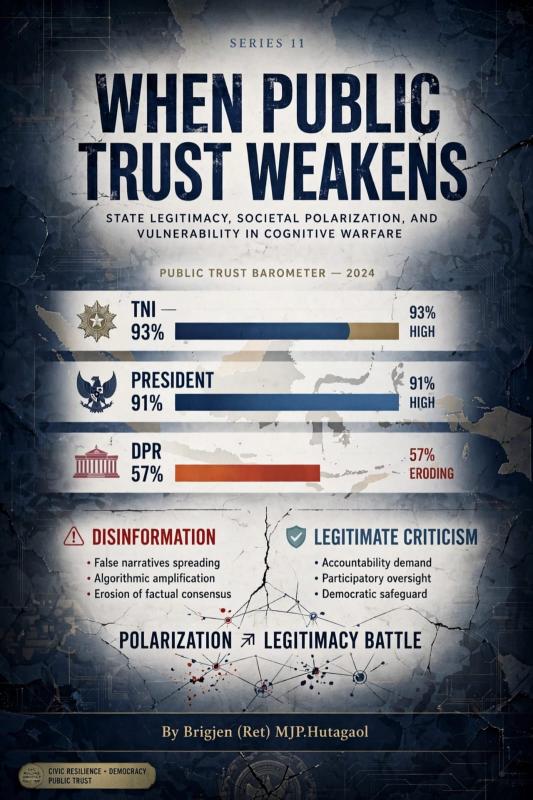
National survey by Indikator Politik Indonesia conducted January 15-21, 2026 on 1,220 respondents shows public trust levels:
- TNI: 93%
- President: 91%
- Attorney General`s Office: 80%
- Constitutional Court: 75%
- Courts: 74%
- KPK: 72%
- Police: 67%
- MPR: 67%
- DPD: 64%
- Political parties: 61%
- DPR: 57%
Survey used multistage random sampling from all provinces, via face-to-face interviews. Margin of error ∼2.9% at 95% confidence.
Data shows trust is not evenly distributed across institutions. But it also does not show total collapse of trust.
In fact, trust in DPR increased from 40% in September 2025 to 53% in October 2025 and 57% in January 2026. Indikator concluded trust in state institutions generally tends to be stable or slightly increasing.
Meanwhile, 2026 Edelman Trust Barometer recorded Indonesian respondents` trust in government at 68%, down 7 points from previous year. Edelman also found 90% respondents think government has obligation to bridge differences between groups, but only 47% think government has performed that role well.
Both surveys use different questions and methods. Therefore figures cannot be compared directly.
Initial conclusion: public trust must be read separately by institution, time, and issue. Some institutions gain high trust, some face problems, and trust changes can improve.
In Cognitive Guerrilla study, accuracy in reading this condition is crucial. Do not build threat analysis based on crisis image not supported by data.
*3. VULNERABILITY OFTEN STARTS FROM REAL PROBLEMS*
Public trust does not always weaken because of false information or propaganda.
Injustice, corruption, poor service, law enforcement perceived as inconsistent, economic inequality, and non-transparent government decisions can cause real disappointment.
Problems experienced by people should not be immediately considered as result of manipulation by certain parties.
This is fundamental difference to understand.
Public criticism can arise from direct experience. Demonstrations can emerge because of genuine demands. Differences of opinion are part of democratic life.
For example, actions and public calls like Indonesia Gelap cannot automatically be called cognitive warfare operation. To conclude coordinated operation, additional evidence is needed regarding perpetrators, objectives, coordination, manipulation patterns, and operation methods.
However, real problems can create vulnerability. When complaints are not handled, unverified information easily mixes with facts. When official explanations are not trusted, space for suspicion widens.
Thus, real problems can become gaps later exploited by parties with certain interests.
*4. HOW CAN TRUST BECOME A COGNITIVE BATTLEFIELD?*
Cognitive warfare is competition to influence how humans understand reality, assess information, build trust, and make decisions.
In this study`s framework, Cognitive Guerrilla is approach to understand how guerrilla warfare principles are applied in information and perception space.
Public trust can become one of its battlefields.
Process does not always start with fake news. It can start from real problems then develop through dissemination of incomplete information, twisting facts, identity disguise, or repetition of unproven accusations.
If continuous, some society may experience difficulty distinguishing facts, opinions, assumptions, and manipulation.
Impact is not merely society believing specific information. More serious impact is emergence of suspicion toward all information sources, including those actually trustworthy.
At certain stage, society may lose ability to distinguish grounded criticism, government mistakes, erroneous information, and organized influence operations.
This is cognitive vulnerability to be aware of.
*5. WHY IS COGNITIVE GUERRILLA PRINCIPLE RELEVANT?*
In conventional guerrilla war, weaker party does not have to face larger force through open battle. They choose terrain, timing, targets, and methods according to limitations.
That principle helps explain competition pattern in cognitive space.
Seven principles to note:
First, asymmetry. Smaller party does not need resources as large as state. Information gaps, communication errors, or unresolved problems can become disproportionate source of influence.
Second, dispersion. Information and influence can move through many networks and groups. Therefore observation is not enough focusing only on one account or one communication channel.
Third, vulnerability selection. Unresolved problems, injustice, and weak trust can be vulnerable points. However existence of such problems does not automatically prove certain party is exploiting them.
Fourth, momentum. Major events, crises, conflicts, or controversial decisions can increase public attention. Timing and context of information dissemination also determine impact.
Fifth, surprise. Fake information, identity disguise, or manipulative material appearing when society is not ready to check can cause confusion.
Sixth, adaptation. Patterns of information dissemination and how society consumes it continue to change. Therefore ability to check and respond must also evolve.
Seventh, endurance. Influence does not always produce instant change. Repetition and information pressure can last long. Society and state institutions need resilience to keep judgment clear.
These seven principles are analytical framework used in this Cognitive Guerrilla series. Framework is not official NATO doctrine nor universally standardized theory.
What needs emphasis: defense objective is not silencing public thought, but maintaining public ability to assess reality independently and make decisions based on accountable information.
*6. FROM DISTRUST TO POLARIZATION*
When trust weakens on certain issues, society can become more divided in assessing an event.
One group may accept government explanation, while other rejects. This difference is not always dangerous. Problem emerges when difference becomes hostility, when every information is judged based on who delivers, not based on evidence.
In such condition, facts can lose to group identity.
Information supporting own belief is more easily accepted, while contradictory information tends to be rejected. Discussion space becomes space of mutual suspicion.
If this situation is exploited by organized influence operations, impact can widen: inter-group trust declines, public decisions increasingly difficult to accept, and national problem solving becomes more complicated.
However, polarization should not always be considered result of external operation. Political competition, social inequality, different interests, and experience of injustice can also be causes.
Therefore cognitive warfare analysis must distinguish real causal factors from alleged interference or manipulation.
*7. IS EVERY DECLINE IN TRUST AN ORGANIZED OPERATION?*
No.
Decline in trust, criticism of government, demonstrations, political campaigns, and dissemination of opinions on social media are not in themselves evidence of organized cognitive warfare.
To conclude existence of influence operation, stronger evidence is needed:
1. Existence of perpetrator or network that can be reasonably identified.
2. Existence of specific objective to influence perception or decision.
3. Existence of coordination, role division, or unnatural distribution pattern.
4. Existence of identity disguise, material falsification, or information manipulation.
5. Existence of evidence of connection between activity and interest to be achieved.
Message repetition or same hashtag use alone is not enough to prove coordinated operation.
Examination must be done through digital evidence, communication context, timing patterns, network connections, and testable information sources.
This principle is important so state does not misidentify threat. Do not let legitimate criticism be considered attack, while truly organized manipulation goes undetected.
*8. STRATEGIC IMPACT FOR NATIONAL RESILIENCE*
Public trust is directly related to state`s ability to implement policies and face crises.
When society believes decision-making process is fair and accountable, even difficult policies are more likely to be understood and accepted.
Conversely, when trust weakens, policies actually needed may face greater rejection. Official explanations difficult to accept, community coordination disrupted, and nation`s energy absorbed in perception conflicts.
In emergency situations, such as disasters, outbreaks, security disruptions, or economic pressures, that condition can slow joint response.
Therefore public trust is not merely matter of government image. It is part of national resilience.
OECD survey 2026 on member states and accession candidate countries shows that level of trust in national government differs greatly between respondents who feel they have voice in decision-making and those who feel they have no voice.
In OECD countries, that trust level reaches 69% in group feeling they have voice, compared to 22% in group feeling no voice. Difference 47 percentage points.
That figure is not Indonesian data. However finding shows importance of participation and feeling heard in building trust in government.
*9. DEFENSE STRATEGY: RESTORING TRUST, NOT FORCING TRUST*
Facing cognitive vulnerability is not enough by multiplying official statements or building positive image of government.
Strongest defense actually starts from real improvement.
Several strategic steps need to be taken:
First, solving problems that become source of dissatisfaction. Government must dare to admit shortcomings, improve services, and take action against violations fairly.
Second, building open communication. Information must be delivered quickly, clearly, consistently, and verifiably. Mistakes must be corrected, not covered up.
Third, strengthening community information literacy. Society needs to be equipped with ability to distinguish facts, opinions, assumptions, and deliberately manipulated information.
Fourth, protecting space for criticism. Legitimate criticism is early warning source for state. Silencing criticism can actually widen gap between government and society.
Fifth, increasing ability to detect coordinated operations. Examination must be evidence-based, done professionally, and not making different opinions basis for accusations.
Sixth, strengthening justice and institutional accountability. Trust cannot be built only through communication. It must be proven through actions and consistency.
Seventh, maintaining unity without uniforming thought. Strong nation is not nation without differences, but nation able to manage differences without losing common interests.
*10. WHAT INDONESIA NEEDS TO MONITOR*
In facing cognitive warfare development, monitoring needs to be directed to:
- Changes in public trust level toward state institutions over time.
- Difference between official statements, policy implementation, and real experience of society.
- Emergence of false information, identity disguise, or repeated manipulative material.
- Coordination patterns and information dissemination that can be proven through examination.
- Development of polarization that hinders dialogue and problem solving.
- Ability of state institutions to respond to criticism, correct mistakes, and present evidence.
- Impact of information on community decisions and smooth implementation of public policies.
Such monitoring should not turn into surveillance of all public criticism. Focus is detecting manipulation and provable threats, while fixing state`s own weaknesses.
*CLOSING: TRUST IS NATIONAL RESILIENCE*
In Cognitive Guerrilla, public trust is one element that can be contested and used as vulnerability.
Party with smaller power can gain influence if able to exploit gaps, momentum, and weaknesses not promptly fixed. However, not every public disappointment is result of operation by certain party.
State must be able to distinguish legitimate criticism, real problems, information errors, and organized manipulation.
State strength is not built by demanding people always trust. That strength grows when government works fairly, open to correction, and able to prove decisions taken favor national interest.
In cognitive warfare, best defense is not forcing people to trust state, but making state worthy of being trusted by its people.
*REFERENCES*
1. Indikator Politik Indonesia. (2026). Public Perception of Presidential Performance, Trust in State Institutions, and Free Nutritious Meal Program (MBG). National survey findings release, February 8, 2026. Data collection January 15-21, 2026.
https://indikator.co.id/wp-content/uploads/2026/02/RILIS_SURVEI_NASIONAL_INDIKATOR_08_FEBRUARI_2026.pdf
2. Edelman Trust Institute. (2026). 2026 Edelman Trust Barometer: Indonesia Report.
https://www.edelman.com/sites/g/files/aatuss191/files/2026-05/2026%20Edelman%20Trust%20Barometer_Indonesia%20Report.pdf
3. OECD. (2026). OECD Survey on Drivers of Trust in Public Institutions 2026 Results.
https://www.oecd.org/en/publications/oecd-survey-on-drivers-of-trust-in-public-institutions-2026-results_9eb63fec-en.html
4. OECD. (2024). OECD Survey on Drivers of Trust in Public Institutions 2024 Results: Trust and Information Integrity.
https://www.oecd.org/en/publications/oecd-survey-on-drivers-of-trust-in-public-institutions-2024-results_9a20554b-en/full-report/trust-and-information-integrity_49ce5100.html
5. Beetham, D. (1991). The Legitimation of Power. Macmillan.
Jakarta, November 17, 2026
Brig. Gen. (Ret.) MJP. Hutagaol