
PRABOWO AND INDONESIA`S FOUNDATION ARCHITECTURE
PRABOWO AND INDONESIA'S FOUNDATION ARCHITECTURE
Reporter: luska
Redaktur: Rikard Djegadut
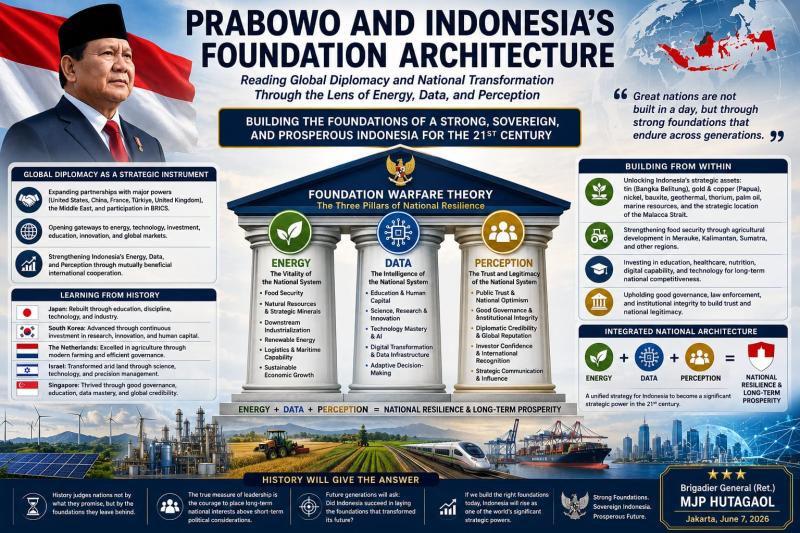
Reading Global Diplomacy and National Transformation Through the Lens of Energy, Data, and Perception
Jakarta, June 7, 2026
By: Brigadier General (Ret.) MJP Hutagaol
WHY GREAT NATIONS RISE AND FALL
Human history is, in essence, the history of civilizations that succeeded—or failed—in building and preserving their foundations.
Many great powers did not collapse because they were defeated on the battlefield. They declined because the pillars supporting their national life gradually eroded from within.
The Roman Empire lost its greatness when its economic strength weakened, social discipline declined, and governance deteriorated.
The Soviet Union did not disintegrate because of foreign military invasion, but because of economic stagnation, technological backwardness, rigid bureaucracy, and the loss of public confidence in its political system.
In contrast, Japan, devastated after the Second World War, rebuilt itself into one of the world's leading economic powers through investment in education, discipline, technology, industry, and human capital.
South Korea followed a similar path by investing consistently in science, research, innovation, and national productivity.
Singapore demonstrated that even a small nation with limited natural resources can become a global financial and trading hub through effective governance, quality education, data mastery, and international credibility.
These historical experiences suggest that the true strength of a nation is not determined solely by territory, population, or natural resources.
It is determined by the quality of the foundations that sustain its entire national system.
The twenty-first century is witnessing a fundamental transformation in global competition.
Geopolitical rivalry, trade wars, artificial intelligence, strategic minerals, energy security, food security, and digital transformation all indicate that the world is entering a new era.
Modern conflict is no longer confined to conventional battlefields.
It has shifted toward competition over the fundamental pillars that sustain national power.
From the perspective of Foundation Warfare Theory, three strategic pillars determine the resilience of a modern state: Energy, Data, and Perception.
Energy represents not only oil, gas, or electricity, but also food security, water resources, strategic minerals, industrial capability, logistics, and the sustainability of national economic life.
Data encompasses knowledge, technology, artificial intelligence, digital governance, scientific capability, and the ability to make rapid and adaptive strategic decisions.
Perception reflects public trust, international reputation, strategic communication, diplomacy, and the ability to shape influence in global affairs.
Nations capable of strengthening these three pillars will possess greater resilience in facing the uncertainties of the twenty-first century.
Conversely, nations that neglect these foundations risk economic vulnerability, social instability, political dependence, and the gradual erosion of their sovereignty.
From this perspective, Indonesia's contemporary diplomacy and national development policies may be understood not as isolated programs, but as components of a broader national strategy to build a new foundation for the future.
GLOBAL DIPLOMACY AND INDONESIA'S FOUNDATION ARCHITECTURE
History demonstrates that no major power has achieved lasting prosperity by relying solely on its domestic resources.
The United States expanded its influence through extensive economic, technological, and security alliances across the world. China has strengthened its global position through the Belt and Road Initiative, connecting investment, infrastructure, logistics, and international trade across continents. Japan, despite its limited natural resources, secured its future by building global partnerships for energy supplies, industrial raw materials, science, and advanced technology. Singapore transformed itself into a global hub by embracing international cooperation in finance, education, innovation, and trade.
These experiences illustrate that in the twenty-first century, national resilience cannot be separated from the ability to establish mutually beneficial international networks.
From this perspective, the diplomatic initiatives undertaken by President Prabowo Subianto deserve careful attention.
Viewed individually, his overseas visits may appear to be ordinary state diplomacy. However, when observed as part of a broader strategic pattern, they reveal a systematic effort to expand Indonesia's national foundations through cooperation in energy, trade, investment, education, technology, strategic industries, defense, and international diplomacy.
Global competition has entered a far more complex era.
Power is no longer measured solely by military capability, but increasingly by control over energy resources, food security, strategic minerals, artificial intelligence, digital technology, data infrastructure, industrial supply chains, investment flows, and international trust.
Diplomacy in the twenty-first century has therefore evolved beyond ceremonial meetings and diplomatic exchanges.
It has become a strategic instrument for strengthening the three pillars of national resilience.
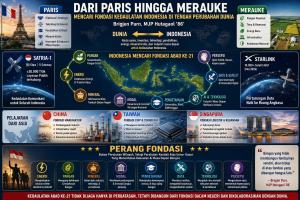
Through international cooperation, Indonesia seeks to reinforce its Energy foundation by expanding investment, promoting downstream industrialization, strengthening food security, and securing strategic supply chains.
Through collaboration in education, scientific research, technological innovation, artificial intelligence, and digital transformation, Indonesia seeks to strengthen its Data foundation, enhancing national competitiveness through knowledge and technological capability.
At the same time, active diplomacy, international engagement, and constructive global partnerships contribute to strengthening Perception by building credibility, international trust, and Indonesia's strategic position within an increasingly multipolar world.
Within this dimension of perception emerge international legitimacy, investor confidence, and global recognition of Indonesia's stability and long-term potential.
From this perspective, Indonesia's relations with the United States, China, France, Türkiye, the United Kingdom, the Middle East, and its participation in BRICS may all be interpreted as components of a broader strategy to expand Indonesia's strategic space amid the transformation of the global order.
Indonesia needs many gateways to the future.
Gateways to energy.
Gateways to technology.
Gateways to investment.
Gateways to education.
Gateways to innovation.
And gateways to global markets.
The broader these international networks become, the stronger Indonesia's national foundations will be.
Nevertheless, diplomacy alone can never guarantee national resilience without strong domestic foundations.
Investment requires legal certainty.
Industrial development requires reliable energy.
Education requires healthy and highly skilled human resources.
Food security requires productive land, advanced technology, and efficient management.
International confidence requires transparent governance and institutional integrity.
Ultimately, global diplomacy and domestic development should not be viewed as separate agendas.
They represent two complementary dimensions of a single national strategy: building Indonesia's Foundation Architecture for the challenges and opportunities of the twenty-first century.
BUILDING THE FOUNDATION FROM WITHIN
No nation can rely solely on diplomacy if its domestic foundations remain fragile.
History repeatedly demonstrates that countries capable of enduring global transformation are not necessarily those blessed with abundant natural resources, but those able to convert their national potential into sustainable strategic strength.
Japan rebuilt itself through education, discipline, technology, and industrial development.
South Korea strengthened its competitiveness through continuous investment in research, innovation, and human capital.
The Netherlands became one of the world's leading agricultural producers through modern farming and efficient governance.
Israel transformed arid land into productive agriculture through science, technology, and precision resource management, while China achieved unprecedented economic transformation through industrialization and large-scale infrastructure development.
These experiences convey a common lesson: the future of a nation depends on the strength of the foundations it builds from within.
Within the framework of Foundation Warfare Theory, the first pillar is Energy.
Energy should not be understood merely as oil, gas, or electricity. It encompasses every strategic resource that sustains national life, including food security, water resources, strategic minerals, industrial capacity, logistics, maritime resources, and the long-term sustainability of the national economy.
Indonesia possesses extraordinary strategic assets.
The Bangka Belitung Islands are among the world's major tin-producing regions. Papua contains some of the world's largest reserves of gold and copper. Indonesia also holds vast deposits of nickel and bauxite, while possessing one of the largest geothermal potentials on Earth that remains only partially utilized. In addition, thorium has emerged as a promising future energy resource attracting increasing global attention.
Indonesia is also one of the world's leading palm oil producers, possesses immense maritime resources, and occupies a strategic position between the Indian and Pacific Oceans. For centuries, the Strait of Malacca has served as one of the world's most important maritime trade routes, highlighting Indonesia's enduring geopolitical significance.
These national assets will generate far greater value when combined with downstream industrialization, technological mastery, domestic manufacturing capability, and effective governance that transforms natural wealth into long-term national prosperity.
Within the same perspective, strengthening food security through agricultural development in Merauke, Kalimantan, Sumatra, and other regions represents an essential effort to reinforce Indonesia's Energy foundation.
Food is not merely an economic commodity.
It is the foundation of national sovereignty.
The second pillar is Data.
In the twenty-first century, scientific knowledge, advanced technology, artificial intelligence, digital transformation, research, and innovation have become decisive factors of national competitiveness.
Investment in education, healthcare, nutrition, digital capability, and technological advancement should therefore be viewed as long-term strategic investment rather than short-term expenditure.
Nations rich in knowledge and innovation will ultimately possess greater resilience than nations relying solely on natural resources.
The third pillar is Perception.
Perception reflects the ability to build trust among citizens, investors, business communities, and international partners.
Within this dimension emerge legitimacy, national optimism, institutional credibility, and confidence that development is conducted transparently, responsibly, and in accordance with national interests.
Good governance, consistent law enforcement, institutional integrity, and the courage to evaluate and improve public policy therefore become essential components of strengthening this pillar.
If Energy provides vitality, Data provides intelligence, and Perception builds trust, then together these three pillars constitute the emerging architecture of Indonesia's national transformation.
The challenge facing Indonesia is no longer simply accelerating economic growth.
The greater challenge is integrating its enormous national potential into a coherent, sustainable, and resilient foundation capable of supporting Indonesia's development throughout the twenty-first century.
INTEGRATING INDONESIA'S FOUNDATION FOR THE TWENTY-FIRST CENTURY
At this point, a fundamental question naturally emerges.
Are Indonesia's diplomatic initiatives, food security programs, downstream industrialization policies, human capital development, digital transformation, and people's economic empowerment merely independent government programs, or are they components of a much larger national architecture?
History suggests that great nations are never built through fragmented policies.
They are built through a coherent vision capable of integrating multiple sectors into a unified and sustainable national strategy.
This distinction separates sectoral development from civilizational development.
Sectoral development produces individual programs.
Strategic architecture integrates those programs into a comprehensive national transformation.
From the perspective of Foundation Warfare Theory, such an architecture rests upon three interconnected pillars: Energy, Data, and Perception.
Energy provides the vitality of the national system through food security, strategic resources, downstream industrialization, renewable energy, logistics, maritime capability, and sustainable economic development.
Data provides intelligence through education, scientific research, technological mastery, artificial intelligence, digital transformation, innovation, and adaptive decision-making.
Perception builds public trust, investor confidence, diplomatic credibility, and international recognition, creating the social legitimacy required for long-term national development.
These three pillars cannot function independently.
Energy without Data loses efficiency and competitiveness.
Data without Energy cannot generate sustainable prosperity.
Energy and Data without Perception will struggle to gain public confidence and international support.
Consequently, diplomacy, food security, industrialization, technological development, human capital investment, digital transformation, cooperative economics, and institutional reform should not be viewed as isolated public policies.
They represent interconnected components of a single national architecture.
If diplomacy opens doors to the world, food security sustains national survival.
If downstream industrialization transforms natural resources into added value, education and technology transform human beings into drivers of civilization.
If local economies are strengthened from villages to urban centers, national resilience will become increasingly robust in facing global uncertainty.
Within this framework, the success of a nation can no longer be measured solely by economic growth or foreign investment.
Its true strength lies in its ability to integrate Energy, Data, and Perception into a unified national capability.
Nations capable of synchronizing these three strategic pillars will possess greater resilience in navigating geopolitical competition, geoeconomic transformation, and technological disruption throughout the twenty-first century.
Ultimately, Indonesia is not merely constructing roads, ports, industrial estates, schools, or digital infrastructure.
Indonesia is laying the foundations of a new national civilization.
The strategic question for the future is therefore not simply whether Indonesia can grow economically, but whether it can build a sustainable Foundation Architecture capable of positioning the nation not merely as a global market, but as one of the world's significant strategic powers in the twenty-first century.
HISTORY WILL GIVE THE ANSWER
Ultimately, the destiny of a nation is never determined by a single policy, a single program, or a single administration.
History moves on a far longer timeline than any political cycle. It does not judge nations by the number of speeches delivered, the scale of public projects inaugurated, or the intensity of political debate during a particular era.
History judges nations by the strength of the foundations they leave behind.
The twenty-first century is transforming the very nature of global competition. Power is no longer defined solely by military capability or natural resources, but increasingly by the ability to master Energy, Data, and Perception as the strategic foundations of national resilience.
At the same time, the global arena is no longer shaped exclusively by nation-states. Technology corporations, artificial intelligence developers, satellite communication networks, digital platforms, global investment institutions, and innovators capable of controlling information and technology have become influential actors in shaping the future world order.
The emergence of electric mobility, artificial intelligence, satellite constellations such as Starlink, digital ecosystems, and the race for strategic minerals and space technology illustrates that global competition has shifted from territorial conquest toward the mastery of the foundations of modern civilization.
Within this perspective, Indonesia possesses extraordinary strategic advantages: abundant natural resources, one of the world's most important geopolitical locations, vast maritime potential, demographic strength, and cultural diversity that has long united the archipelago.
Yet these advantages alone will never guarantee national greatness.
Only through visionary leadership, sound governance, technological mastery, scientific advancement, and the ability to build trust at home and abroad can these resources be transformed into lasting national power.
From this perspective, the policies pursued by President Prabowo Subianto may be interpreted not as isolated government programs, but as components of a broader effort to strengthen Indonesia's foundations through the integration of Energy, Data, and Perception in response to the profound transformation of the global order.
Naturally, every policy will encounter criticism, challenges, and the need for continuous improvement.
The true measure of leadership lies in the ability to evaluate, adapt, and place long-term national interests above short-term political considerations.
Decades from now, future generations may no longer debate who governed Indonesia during this period.
Instead, they may ask a far more fundamental question:
Did Indonesia, in its time, succeed in laying the foundations that transformed its future?
History alone will provide the answer.
For nations are remembered not by the number of projects they build, but by the enduring foundations of civilization they leave to future generations.
Jakarta, June 7, 2026
By: Brigadier General (Ret.) MJP Hutagaol