
WHEN CAPITAL WALKS HAND IN HAND WITH POWER
WHEN CAPITAL WALKS HAND IN HAND WITH POWER
Reporter: luska
Redaktur: Rikard Djegadut
Reflections from the VOC to Modern Democracy
PART I
FROM THE VOC, COLONIAL INTERMEDIARIES, TO MODERN DEMOCRACY
Jakarta, June 16, 2026
History demonstrates that nations do not always lose their sovereignty through open military confrontation. More often, political influence emerges gradually through commerce, financial power, economic monopolies, strategic investment, debt, and the accumulation of capital that eventually shapes the direction of state authority.
The Indonesian experience provides a compelling illustration of this historical pattern.
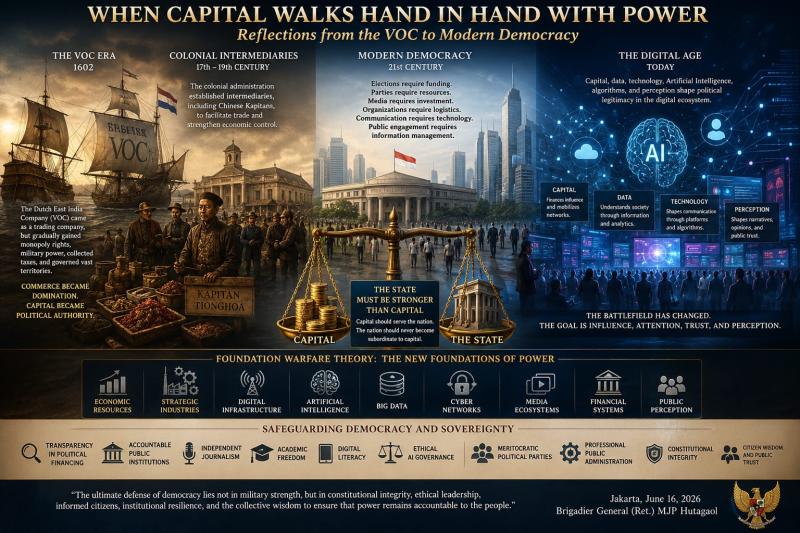
When the Dutch East India Company (VOC) arrived in the Indonesian archipelago in 1602, it entered as a commercial corporation seeking profit from the global spice trade. Its initial objective was economic expansion rather than territorial conquest.
History, however, took a different course.
The VOC gradually acquired monopoly rights over trade, established military fortifications, maintained its own armed forces, collected taxes, negotiated political agreements with indigenous kingdoms, and eventually exercised governmental authority across vast regions of the archipelago.
Commerce evolved into domination.
Capital evolved into political authority.
Trade evolved into colonialism.
To consolidate its influence, the Dutch colonial administration established intermediary institutions, including the appointment of Chinese Kapitans in major commercial centers. These local leaders functioned as intermediaries between colonial authorities and trading communities, facilitating economic administration while contributing to the emergence of influential commercial networks within the colonial system.
Comparable historical developments can be observed elsewhere.
In British India, the East India Company began as a private trading corporation but progressively transformed into a political and military institution governing extensive territories long before formal colonial administration was established.
History therefore offers a universal lesson.
Whenever economic power becomes excessively concentrated and gains the capacity to shape political decision-making, the balance between public sovereignty and private interests becomes increasingly vulnerable.
More than four centuries have passed.
Political institutions have evolved.
Technology has transformed civilization.
Global economic systems have become interconnected.
Yet the relationship between capital and political power remains one of the defining questions of contemporary governance.
In the twenty-first century, democracy itself confronts a new strategic reality. Electoral competition requires substantial financial resources. Political organizations require funding. Public communication depends upon increasingly sophisticated media ecosystems. Digital platforms, technological infrastructure, and strategic information management have become indispensable elements of political competition.
Within this evolving landscape, capital no longer functions merely as economic wealth. It increasingly serves as strategic energy capable of mobilizing organizations, financing communication, influencing narratives, and shaping public legitimacy.
This broader interaction between capital, information, technology, organization, and perception may be understood through what can be described as Foundation Warfare Theory—a conceptual framework suggesting that modern competition among political actors and states increasingly unfolds through strategic control of foundational systems rather than through conventional military confrontation alone.
The central question therefore becomes increasingly significant:
Can constitutional democracy continue to produce leaders chosen primarily through the free conscience of citizens, or will political outcomes become progressively influenced by the concentration of financial resources, technological capability, and informational advantage?
This essay does not seek to accuse any particular individual, institution, or nation.
Rather, it invites reflection upon an enduring historical principle: the state must remain stronger than concentrated economic interests, ensuring that constitutional values, democratic legitimacy, and national sovereignty continue to serve the welfare of the people.
History reminds us that nations may lose their independence not only through military defeat but also through the gradual transfer of strategic influence to forces capable of shaping political authority through economic and informational dominance.
The challenge of the twenty-first century is therefore no longer merely the defense of territory, but the preservation of sovereignty in an age where capital, data, technology, and perception increasingly determine the architecture of power itself.
PART II
WHEN DEMOCRACY BECOMES EXPENSIVE
Capital, Data, Technology, and Perception as the New Battlefield
The historical transformation of commerce into political influence did not end with the decline of colonial empires. Instead, it evolved into increasingly sophisticated interactions between economic power, technological capability, information systems, and political authority.
The twenty-first century has introduced a strategic environment in which political competition is no longer determined solely by ideology, institutions, or military capability. It increasingly depends upon the interaction of capital, data, technology, organizational networks, and public perception.
Modern democracy requires enormous resources.
Political parties require funding.
Election campaigns require financing.
Media exposure requires investment.
Organizational structures require logistics.
Digital communication requires technological infrastructure.
Public engagement demands continuous information management.
The larger the democratic arena, the greater the financial energy necessary to sustain political competition.
Within the perspective of Foundation Warfare Theory, capital functions as strategic energy capable of mobilizing organizations, financing communication, expanding political networks, and sustaining influence across society.
Yet financial resources alone are no longer sufficient.
The digital revolution has elevated data into one of the most valuable strategic assets of the modern era.
Information concerning citizens' behavior, political preferences, digital habits, social interactions, and patterns of communication can now be processed through Artificial Intelligence, machine learning, and advanced analytics to generate remarkably detailed behavioral and psychological profiles.
Technology transforms information into strategic capability.
Algorithms determine visibility.
Digital platforms determine distribution.
Artificial Intelligence accelerates decision-making.
Social media amplifies narratives.
Together, they create an entirely new ecosystem of political competition.
Political contests therefore no longer occur exclusively in campaign rallies, legislative chambers, or public debates.
They unfold continuously across smartphones, social media platforms, search engines, digital ecosystems, recommendation algorithms, streaming platforms, and interconnected information networks.
The battlefield has fundamentally changed.
The objective is no longer merely territorial control.
The objective is influence.
The objective is attention.
The objective is trust.
The objective is perception.
Public opinion can be shaped through strategic communication, algorithmic recommendation systems, digital advertising, influencers, automated accounts, opinion surveys, information management, and sophisticated narrative construction.
When perception changes, political preferences may change.
When political preferences change, electoral outcomes may change.
When electoral outcomes change, national policy may also change.
Capital, data, technology, organization, and perception have therefore become interconnected strategic foundations of contemporary political competition.
This phenomenon is not unique to Indonesia.
It represents a global transformation affecting democratic systems across continents.
The central question confronting constitutional democracies today is no longer simply who governs, but how political legitimacy is created, financed, communicated, and sustained within an increasingly digital civilization.
Healthy democracy therefore requires far more than periodic elections.
It requires transparency in political financing, institutional accountability, independent journalism, civic education, digital literacy, technological ethics, and citizens capable of critically evaluating information within increasingly complex information ecosystems.
Indonesia's constitutional philosophy offers an enduring moral foundation through the Fourth Principle of Pancasila, emphasizing democracy guided by wisdom through deliberation and representation.
Political leadership should emerge from integrity, wisdom, public service, and constitutional responsibility rather than from financial superiority, technological dominance, or informational advantage alone.
History reminds humanity that trading corporations once evolved into political authorities.
The digital era reminds us that capital, data, technology, Artificial Intelligence, and perception may together become instruments capable of shaping political legitimacy without a single conventional military confrontation.
In the twenty-first century, whoever controls capital may finance influence.
Whoever controls data may understand society.
Whoever controls technology may shape communication.
But whoever controls public perception may ultimately shape political legitimacy itself.
For this reason, the resilience of constitutional democracy increasingly depends upon the ability of the state and its citizens to preserve sovereignty over their foundational systems.
PART III
THE STATE MUST BE STRONGER THAN CAPITAL
Safeguarding National Sovereignty in the Age of Foundation Warfare
If Part I examined how commercial enterprises gradually evolved into political authority, and Part II explored how capital, data, technology, and perception have become strategic instruments within modern democracy, then the next fundamental question naturally arises:
How can a constitutional state preserve its sovereignty amid the growing concentration of economic and technological power?
The answer is both simple and profound.
The state must always remain stronger than capital.
This principle does not imply hostility toward business, investment, or economic growth.
On the contrary, every modern nation requires productive investment, technological innovation, entrepreneurial initiative, and competitive private enterprises capable of generating employment, increasing productivity, and improving public welfare.
Economic development remains an essential pillar of national prosperity.
Yet economic power must always operate within the constitutional framework established to protect the public interest.
Capital should serve the nation.
The nation should never become subordinate to capital.
Within the perspective of Foundation Warfare Theory, national power in the twenty-first century can no longer be measured solely by military capability.
Economic resources.
Strategic industries.
Digital infrastructure.
Artificial Intelligence.
Big Data.
Cyber networks.
Media ecosystems.
Financial systems.
Public perception.
These have become strategic foundations capable of influencing national policy, political legitimacy, and even the long-term direction of state institutions.
Competition increasingly occurs without military confrontation.
Influence replaces occupation.
Algorithms replace artillery.
Information replaces ammunition.
Perception replaces psychological warfare.
Power itself has entered a new strategic dimension.
For this reason, constitutional democracy requires stronger institutional resilience than ever before.
Political financing must remain transparent.
Public institutions must remain accountable.
Independent journalism must be protected.
Academic freedom must flourish.
Digital literacy must expand.
Artificial Intelligence must be governed ethically.
Political parties must strengthen meritocratic leadership and democratic internal governance rather than dependence upon financial patronage alone.
Likewise, public administration must continue evolving toward professionalism, transparency, accountability, and digital governance capable of minimizing corruption, reducing administrative inefficiency, and strengthening public trust.
Ultimately, however, institutional reform alone is insufficient.
Every constitutional democracy requires a moral foundation.
Indonesia possesses such a foundation through Pancasila, particularly its Fourth Principle, which emphasizes democracy guided by wisdom through deliberation and representation.
Wisdom is more than intellectual ability.
Wisdom is the capacity to place national interest above personal ambition.
Wisdom is the courage to defend constitutional values against political pressure.
Wisdom is the discipline to exercise power as public service rather than private privilege.
The greatness of a nation is not determined by the wealth of its economic elites.
It is determined by its ability to ensure that economic strength remains aligned with national prosperity and democratic legitimacy.
History repeatedly demonstrates that powerful commercial institutions can gradually acquire political influence.
The digital age introduces new instruments.
Capital.
Data.
Artificial Intelligence.
Algorithms.
Digital platforms.
Global information networks.
Their forms may differ from those of earlier centuries, yet their strategic significance remains remarkably similar.
The challenge confronting modern democracies is therefore not merely economic competition.
It is the preservation of sovereignty over the foundational systems that sustain national independence.
A resilient nation requires more than military deterrence.
It requires constitutional integrity.
Institutional credibility.
Educated citizens.
Ethical leadership.
Independent institutions.
And a democratic culture capable of resisting manipulation through wealth, technology, or information dominance.
The history of civilization suggests that every era possesses its own instruments of power.
In the seventeenth century, commercial fleets and colonial monopolies shaped empires.
In the twenty-first century, capital, data, Artificial Intelligence, algorithms, and perception increasingly shape political legitimacy itself.
Nations that fail to preserve sovereignty over these foundational systems may gradually surrender their independence without a single battlefield being crossed.
The ultimate defense of democracy therefore lies not merely in military strength, but in constitutional integrity, ethical leadership, informed citizens, institutional resilience, and the collective wisdom to ensure that power always remains accountable to the people.
Only under such conditions can democracy continue to produce leaders chosen through public trust rather than financial superiority.
Only under such conditions can sovereignty genuinely remain in the hands of the people.
EPILOGUE
FROM COLONIAL COMMERCE TO DIGITAL INFLUENCE
Lessons for the Twenty-First Century
The history of human civilization is, in many respects, the history of changing instruments of power.
Empires once expanded through armies, naval fleets, and territorial conquest.
Later, global commerce became the principal vehicle of influence.
Trading corporations accumulated wealth.
Economic power generated political leverage.
Commercial networks evolved into systems of governance.
The experiences of the Dutch East India Company in the Indonesian Archipelago and the British East India Company in India demonstrate that economic institutions, when sufficiently concentrated, may gradually acquire political authority far beyond their original commercial purposes.
History therefore leaves an enduring lesson:
Power never truly disappears.
It merely changes its form.
The twenty-first century represents another profound transformation.
The strategic resources of nations are no longer confined to territory, natural resources, industrial capacity, or military strength alone.
Capital.
Data.
Artificial Intelligence.
Digital infrastructure.
Algorithms.
Information networks.
Media ecosystems.
Public perception.
These have emerged as the new foundations upon which influence, legitimacy, and national competitiveness increasingly depend.
The architecture of power has entered a new era.
Competition now unfolds simultaneously across financial markets, cyberspace, communication platforms, technological ecosystems, and public consciousness.
The struggle for influence increasingly occurs without visible confrontation.
Without military occupation.
Without conventional warfare.
Without territorial invasion.
Instead, it develops through narratives, information flows, technological platforms, financial concentration, and the gradual shaping of collective perception.
Within this context, Foundation Warfare Theory proposes that modern strategic competition extends beyond military capability toward the control of foundational systems that sustain national resilience and political legitimacy.
The future of sovereignty will therefore depend not only upon armed forces, but also upon a nation's capacity to protect its economic independence, digital infrastructure, technological innovation, institutional credibility, constitutional order, and public trust.
For Indonesia, this challenge carries particular historical significance.
Having experienced centuries of colonial domination through commercial expansion and economic monopolization, Indonesia possesses valuable historical experience regarding the relationship between capital and political authority.
The lessons of history should not generate suspicion toward economic development or international cooperation.
Rather, they should encourage stronger constitutional institutions, transparent governance, ethical leadership, accountable political financing, digital literacy, and informed citizenship capable of safeguarding democratic legitimacy.
Economic growth remains indispensable.
Investment remains necessary.
Innovation remains essential.
Technology remains inevitable.
Yet all of these must remain aligned with constitutional values and the collective interests of the people.
Capital should strengthen sovereignty.
Technology should empower society.
Information should enlighten citizens.
Democracy should protect liberty.
Government should remain accountable to the nation rather than to concentrated private interests.
History never truly repeats itself, yet it often returns in different forms.
Yesterday, ships carried spices across the oceans and altered the destiny of nations.
Today, capital, data, algorithms, Artificial Intelligence, and perception travel through invisible digital networks capable of shaping political legitimacy and national sovereignty.
The challenge for every democracy is therefore not to reject progress, but to ensure that every technological and economic transformation remains firmly anchored to constitutional values, ethical leadership, and the enduring principle that sovereignty belongs to the people.
The future will not belong merely to those who possess the greatest wealth, the largest databases, or the most advanced technologies.
The future will belong to nations that possess the wisdom to ensure that power, in all its evolving forms, remains accountable to the public good and the constitutional order.
Only then can democracy remain genuine.
Only then can sovereignty remain secure.
Only then can civilization advance without sacrificing its humanity.
Jakarta, June 16, 2026
Brigadier General (Ret.) MJP Hutagaol