
RADEN WIJAYA AND SUN TZU: WHY GREATER MILITARY STRENGTH DOES NOT ALWAYS GUARANTEE VICTORY
RADEN WIJAYA AND SUN TZU: WHY GREATER MILITARY STRENGTH DOES NOT ALWAYS GUARANTEE VICTORY
Reporter: luska
Redaktur: Rikard Djegadut
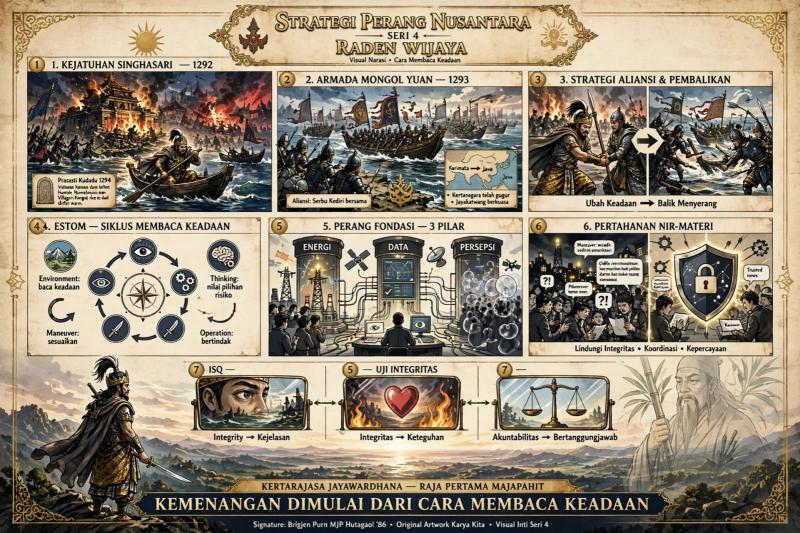
STRATEGY OF NUSANTARA WARFARE — SERIES 4
Understanding changing circumstances, exploiting momentum, and preserving freedom of action
Jakarta, 30 October 2026
Brigjen (Purn) MJP.Hutagaol
1. WHEN A SMALLER FORCE FACES A GREATER POWER
History repeatedly demonstrates that victory in war is not determined solely by the size of an army, the number of weapons, or the superiority of military technology.
A force that appears weaker can prevail when it understands the situation, recognizes opportunities, manages alliances, and chooses the right moment to act.
One example from the history of the Indonesian archipelago is the rise of Raden Wijaya and the establishment of Majapahit in the late thirteenth century.
Raden Wijaya faced a complex situation. The Kingdom of Singhasari had collapsed following the attack by Jayakatwang in 1292. Kertanegara, the last ruler of Singhasari, was killed. Raden Wijaya, one of the surviving members of the royal family, had to escape and find a way to rebuild his position.
At the same time, a powerful Mongol expeditionary force sent by Kublai Khan arrived in Java in 1293. This force was part of the Yuan dynasty, which ruled China at the time.
The circumstances created a difficult strategic environment. Raden Wijaya did not possess military strength comparable to that of the Mongol expedition. Yet, through a sequence of political and military decisions, he managed to use the changing situation to his advantage.
This episode offers an important lesson: the ability to read circumstances and manage opportunities can be as decisive as military strength itself.
2. RADEN WIJAYA: READING THE SITUATION AND USING MOMENTUM
After the fall of Singhasari, Raden Wijaya sought refuge and support. The Kudadu inscription, dated 1294, records the assistance given by the village leader of Kudadu to Raden Wijaya and his followers as they fled toward Madura.
This historical record is important because it shows that the survival of a political leader and the preservation of his followers depended not only on military power, but also on local support and the ability to maintain relationships.
When the Mongol forces arrived in Java in 1293, the political situation had changed. Kertanegara was already dead, and Jayakatwang had taken power.
Raden Wijaya cooperated with the Mongol expeditionary force in its campaign against Jayakatwang. After Jayakatwang was defeated, Raden Wijaya turned against the Mongol forces.
The Mongol troops eventually withdrew from Java. Raden Wijaya then established the Majapahit kingdom.
The historical sequence illustrates how a political and military situation can change rapidly. An external force that initially becomes an ally can later become a strategic obstacle.
However, historical analysis must distinguish documented facts from later interpretation. The Kudadu inscription records the assistance received by Raden Wijaya, but it does not provide a detailed account of the battles against the Mongol forces. The military sequence must therefore be understood through a broader reading of historical sources.
We should not invent undocumented conversations, signals, or private thoughts. What can be examined is the sequence of decisions and the changing balance of power.
3. RADEN WIJAYA AND SUN TZU: A STRATEGIC COMPARISON
The experience of Raden Wijaya can be compared with several principles found in The Art of War, written by Sun Tzu.
There is, however, no historical evidence that Raden Wijaya directly studied or applied Sun Tzu`s teachings. This comparison is conceptual: it examines similarities in strategic reasoning, not a proven historical connection.
Several dimensions are worth considering.
First: Understanding the situation.
Sun Tzu emphasizes the importance of understanding one`s own position, the opponent, and the conditions of the battlefield.
Raden Wijaya`s experience demonstrates the importance of understanding the political situation after the collapse of Singhasari and the arrival of the Mongol forces.
Second: Momentum.
A strategic opportunity does not remain open indefinitely. The ability to recognize when circumstances are changing can determine whether a force survives or loses its opportunity.
Third: Alliances.
An alliance is not necessarily permanent. It is shaped by interests, circumstances, and the objectives of each party.
The cooperation between Raden Wijaya and the Mongol forces illustrates how an alliance formed to overcome a common opponent can change when the strategic situation changes.
Fourth: Information.
A leader must understand the political environment, the intentions of other actors, and the conditions affecting the movement of forces.
Information is not merely a collection of facts. It becomes strategically valuable when it helps leaders make sound decisions.
Fifth: Endurance.
Survival is a strategic achievement. A force that preserves its core strength and its ability to act may still have opportunities even after suffering a major defeat.
Sixth: The objective after victory.
Winning a battle is not the same as securing a lasting political outcome.
The establishment of Majapahit demonstrates that military success must be followed by the ability to build political authority and maintain stability.
4. READING THE HISTORICAL EXPERIENCE THROUGH ESTOM
The experience of Raden Wijaya can also be examined through ESTOM, a framework for understanding how a strategic environment changes and how decisions are made.
ESTOM consists of five interconnected stages:
- Environment: Understand the overall situation, including political conditions, geography, alliances, and the balance of power.
- Sensing: Identify changes, opportunities, threats, and information emerging from the environment.
- Thinking: Interpret the information, evaluate alternatives, and determine priorities.
- Operation: Translate decisions into concrete actions.
- Maneuver: Adjust the course of action as circumstances change, while preserving the ability to achieve the main objective.
In the case of Raden Wijaya, the collapse of Singhasari, the rise of Jayakatwang, and the arrival of the Mongol expedition created a rapidly changing environment.
The strategic lesson is that leaders cannot rely on a single plan when the environment itself is changing.
They must continuously observe, interpret, decide, and adjust.
ESTOM is a modern analytical framework used here to examine historical events. It is not a term or doctrine attributed to Raden Wijaya or the people of his time.
5. THE FOUNDATION OF POWER: ENERGY, DATA, AND PERCEPTION
The experience of Raden Wijaya also invites us to examine the deeper foundations of national power.
In the framework of Perang Fondasi, the foundations of national strength consist of three pillars:
ENERGY, DATA, AND PERCEPTION.
These three pillars are interconnected.
Energy sustains the ability of a nation to function. It supports military operations, transportation, production, communication, and the continuity of public life.
Data provides the information needed to understand conditions, recognize changes, and make decisions. Without reliable information, leaders may misread the situation and choose the wrong course of action.
Perception influences how people understand events, interpret threats, build trust, and respond to leadership.
Technology, artificial intelligence, chips, drones, cyber capabilities, logistics, food systems, and industrial capacity are important instruments. They strengthen the ability to manage these three foundations, but they are not separate foundational pillars.
The central principle is that a nation must understand and protect the foundations that allow it to survive, function, and determine its own future.
6. NON-MATERIAL DEFENSE: PRESERVING THE ABILITY TO FUNCTION
Military strength is not measured only by weapons, personnel, or physical infrastructure.
A nation also needs to protect the elements that are less visible but essential to its survival.
These include:
- The integrity of information.
- Public trust in institutions.
- The ability to coordinate across government and society.
- The continuity of essential services.
- The capacity to make rational decisions during a crisis.
- The ability to maintain social cohesion under pressure.
This is the essence of Pertahanan Nir-Materi, or Non-Material Defense.
It does not replace conventional defense. Rather, it complements physical defense by protecting the national capacity to remain functional when facing disruption, uncertainty, and pressure.
A country may possess modern weapons and advanced technology, but if its information is manipulated, its institutions lose public trust, and its decision-making process becomes paralyzed, its strategic resilience will weaken.
The lesson is clear: defending a nation also means protecting its ability to think, coordinate, decide, and continue functioning.
7. LEADERSHIP, INTEGRITY, AND RESPONSIBILITY
Strategic intelligence must be accompanied by integrity.
A leader may understand the situation, recognize opportunities, and possess the authority to make decisions. Yet these capabilities must be directed toward a clear and responsible objective.
This is where the concept of ISQ — Inner Spirit Quotient–Integrity Strategic becomes relevant as a reflective framework.
ISQ emphasizes the relationship between inner clarity, integrity, responsibility, and the use of power.
It is not presented as a scientifically standardized psychological measurement. It is a conceptual approach to reminding leaders that strategic capability must be accompanied by ethical responsibility.
The experience of Raden Wijaya can be examined not only through the question of how he overcame his opponents, but also through the larger outcome: the establishment of a political order that became one of the most influential kingdoms in the history of the Indonesian archipelago.
The strategic objective should not end with victory. It must also consider what kind of order is built afterward.
8. WHAT CAN INDONESIA LEARN?
The history of Raden Wijaya is not a blueprint that can be copied directly into the present. The political, technological, and international environments are very different.
Nevertheless, several lessons remain relevant.
First, do not measure national strength only by military size. A country`s ability to understand its environment, manage resources, and make sound decisions is equally important.
Second, maintain strategic independence. Cooperation with other countries is necessary, but national interests and freedom of decision-making must remain protected.
Third, strengthen the foundations of national resilience. Energy security, reliable data, and public trust must be treated as strategic priorities.
Fourth, build the ability to adapt. A strategy that cannot respond to changing circumstances may become a weakness.
Fifth, place integrity at the center of leadership. Power without responsibility can damage the very foundations it is supposed to protect.
In today`s world, competition is no longer limited to conventional military confrontation. It also involves energy, information, technology, economic influence, and public perception.
A nation that fails to understand these dimensions may find itself reacting to events rather than determining its own direction.
9. CONCLUSION: VICTORY BEGINS WITH THE ABILITY TO READ CHANGE
The rise of Raden Wijaya and the establishment of Majapahit offer an important lesson from the history of the Indonesian archipelago.
Greater military strength does not automatically guarantee victory. Strategic outcomes are also shaped by the ability to understand circumstances, recognize momentum, manage alliances, preserve the capacity to act, and determine the political objective after victory.
The comparison with Sun Tzu helps us examine these principles, although there is no evidence of a direct historical connection between the two.
Through ESTOM, we can understand the importance of observing and responding to a changing environment. Through Perang Fondasi, we can recognize that national resilience rests on three essential pillars: Energy, Data, and Perception. Through Pertahanan Nir-Materi, we understand the need to preserve the nation`s ability to function. And through ISQ, we are reminded that strategic power must be guided by integrity and responsibility.
The central lesson is simple:
A nation does not become strong merely because it possesses power. It becomes strong when it understands the foundations of that power, knows how to use it, and has the integrity to direct it toward the future of its people.
---
REFERENCES
1. Kakawin Nagarakretagama by Mpu Prapanca, 1365. A primary literary source for the history and political landscape of Majapahit.
2. The Kudadu Inscription, dated 1294. An important epigraphic source concerning Raden Wijaya`s escape and the assistance he received.
3. Slamet Muljana, Menuju Puncak Kemegahan: Sejarah Kerajaan Majapahit. A historical study of Majapahit and its political development.
4. Sun Tzu, The Art of War. A classical work on strategy, used here for conceptual comparison rather than as evidence of direct influence on Raden Wijaya.


