
FOUNDATION WARFARE: WHY THIS THEORY MUST CONTINUE TO BE TESTED AND OPENLY EXAMINED
FOUNDATION WARFARE: WHY THIS THEORY MUST CONTINUE TO BE TESTED AND OPENLY EXAMINED
Reporter: luska
Redaktur: Rikard Djegadut
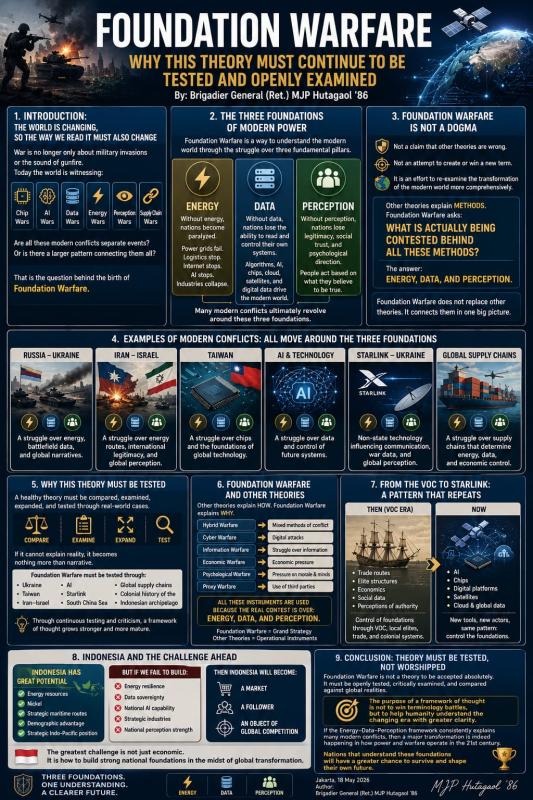
By: Brigadier General (Ret.) MJP Hutagaol ‘86
INTRODUCTION:
THE WORLD IS CHANGING, SO THE WAY WE READ IT MUST ALSO CHANGE
The modern world is changing rapidly.
War is no longer visible only through military invasions or the sound of gunfire.
Today, the world is witnessing:
chip wars,
AI wars,
data wars,
energy wars,
perception wars,
and the struggle over global supply chains.
This raises a major question:
Are all these modern conflicts truly separate events?
Or is there actually a larger pattern connecting them all?
From this question emerged a framework of thought that I call:
FOUNDATION WARFARE.
A way of understanding the modern world through the struggle over three fundamental pillars:
Energy.
Data.
Perception.
This framework is not intended to replace existing theories of modern warfare.
Instead, Foundation Warfare seeks to offer a “strategic lens” for understanding why many modern conflicts appear different on the surface, yet often revolve around similar struggles at their core.
FOUNDATION WARFARE IS NOT A DOGMA
Foundation Warfare is not a claim that all other theories of war are wrong.
Nor is it an attempt to merely create or win a new term.
Instead, Foundation Warfare is an effort to re-examine the transformation of the modern world in a more comprehensive way.
Many modern warfare theories today are already very effective at explaining methods of conflict.
Such as:
hybrid warfare,
cyber warfare,
information warfare,
economic warfare,
psychological warfare,
and AI warfare.
But the deeper question is:
What is actually being contested behind all these methods?
This is where Foundation Warfare offers a different perspective.
It argues that behind many forms of modern conflict, what is truly being contested are:
energy,
data,
and perception.
Therefore, Foundation Warfare does not seek to eliminate other theories.
Instead, it attempts to understand the relationship between various forms of modern conflict within one broader strategic framework.
WHY ENERGY, DATA, AND PERCEPTION?
Because these three elements have become the foundations of modern systems of life.
Without energy, nations become paralyzed.
Power grids fail.
Supply chains collapse.
Internet systems stop functioning.
AI systems cease operating.
Modern industries can break down within days.
Without data, nations lose the ability to understand and manage their own systems.
Because today’s world operates through:
algorithms,
AI,
chips,
cloud systems,
satellites,
and digital information.
Meanwhile, without perception, nations lose legitimacy, social trust, and psychological direction.
In the end, human beings do not act solely based on facts, but based on what they believe to be true.
This is why many modern conflicts revolve around these three elements.
Russia–Ukraine demonstrates the struggle over energy, battlefield data, and global narratives.
Iran–Israel demonstrates the importance of energy routes, international legitimacy, and global perception.
Taiwan demonstrates the struggle over chips and the foundations of global technology.
AI demonstrates the struggle over data and control of future systems.
Even in everyday human life, people move through:
energy,
information,
and trust.
This means:
Foundation Warfare is not merely about wars between states.
It is also a way of understanding how modern systems of life actually function.
WHY MUST THIS THEORY BE TESTED?
Because a healthy theory cannot survive solely on personal belief.
It must be:
compared,
examined,
expanded,
and tested through real-world case studies.
If a theory fails to explain reality, it eventually becomes nothing more than narrative.
That is why Foundation Warfare must continue to be tested through:
Ukraine,
Taiwan,
Iran–Israel,
AI,
Starlink,
global supply chains,
the South China Sea,
and even the colonial history of the Indonesian archipelago.
If the pattern of Energy–Data–Perception continues to appear consistently across different conflicts, then perhaps there truly has been a major transformation in how power and warfare operate in the 21st century.
Therefore, Foundation Warfare should never be treated as a cult-like doctrine.
Instead, it must remain open to:
criticism,
testing,
and further development.
FOUNDATION WARFARE AND OTHER THEORIES
Foundation Warfare does not seek to eliminate other theories.
Instead, it attempts to become a broader framework capable of understanding the relationships among different forms of modern conflict.
Hybrid warfare explains mixed methods of conflict.
Cyber warfare explains digital attacks.
Information warfare explains the struggle over information.
Economic warfare explains economic pressure.
Psychological warfare explains pressure on morale and human psychology.
Proxy warfare explains the use of third parties to weaken opponents.
But Foundation Warfare attempts to answer a deeper question:
Why are all these instruments being used?
The answer is because:
energy,
data,
and perception
have become the primary foundations of modern power.
This is why Foundation Warfare is closer to the level of:
grand strategy.
Meanwhile, many other forms of modern warfare can be understood as operational instruments on the surface.
FROM THE VOC TO STARLINK:
A PATTERN THAT CONTINUES TO REPEAT
If examined more deeply, the struggle over foundations is not entirely new.
The Dutch did not dominate the Indonesian archipelago for centuries through military force alone.
Their numbers were too small.
Instead, they controlled:
trade routes,
elite structures,
economics,
social data,
and perceptions of authority.
The VOC,
Chinese captains,
spice trade routes,
local regents,
and colonial administrative systems
were all forms of foundational control in their era.
Today, the forms have changed.
No longer VOC, but:
AI,
chips,
digital platforms,
satellites,
cloud systems,
and global data networks.
Starlink in the Ukraine war demonstrates how non-state technology can influence:
communications,
intelligence,
battlefield data,
and global perception.
Taiwan demonstrates how semiconductor chips have become a foundation of global geopolitics.
This means:
the form of the struggle has changed, but the underlying pattern remains the same.
INDONESIA AND THE CHALLENGE AHEAD
Indonesia stands in the middle of major global transformation.
We possess:
energy resources,
nickel,
strategic maritime routes,
demographic advantages,
and a highly strategic Indo-Pacific position.
But if Indonesia fails to build:
energy resilience,
data sovereignty,
national AI capabilities,
strategic industries,
and national perception strength,
then Indonesia will become merely:
a market,
a follower,
and an object of global competition.
Therefore, Indonesia’s greatest challenge is not merely economic.
It is:
how to build strong national foundations in the midst of modern global transformation.
Because nations that fail to control their own foundations will eventually be controlled by the foundations of others.
CONCLUSION:
THEORY MUST BE TESTED, NOT WORSHIPPED
Foundation Warfare is not a theory that must be accepted absolutely.
Instead, it must continue to be openly tested, critically examined, and compared against global realities.
Because the ultimate purpose of a framework of thought is not to win terminology battles.
But to help humanity understand the changing era with greater clarity.
If the Energy–Data–Perception framework consistently explains many modern conflicts, then perhaps there truly has been a major transformation in how power and warfare operate in the 21st century.
And if that is true, then nations capable of understanding the foundations of the modern world will have a greater opportunity to survive and shape the direction of their own future.
Jakarta, 18 May 2026
Author:
Brigadier General (Ret.) MJP Hutagaol ‘86