ENERGY, STRATEGIC MINERALS, AND THE FUTURE OF INDONESIAN CIVILIZATION
ENERGY, STRATEGIC MINERALS, AND THE FUTURE OF INDONESIAN CIVILIZATION
Reporter: luska
Redaktur: Rikard Djegadut
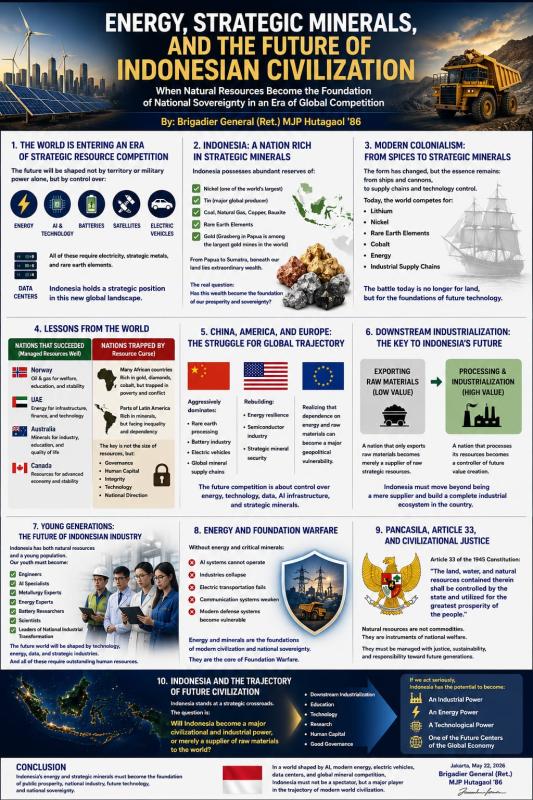
When Natural Resources Become the Foundation of National Sovereignty in an Era of Global Competition
By: Brigadier General (Ret.) MJP Hutagaol ‘86
INTRODUCTIONTHE WORLD IS ENTERING AN ERA OF STRATEGIC RESOURCE COMPETITION
The modern world is undergoing a profound transformation.
If previous centuries were largely defined by struggles over:
territory,
military dominance,
and physical colonialism,
the modern era is increasingly shifting toward:competition over energy, strategic minerals, technology, and control of future industrial systems.
Today, the world is entering the age of:
electric vehicles,
Artificial Intelligence,
data centers,
advanced military technology,
satellites,
battery systems,
and future energy infrastructure.
All of these developments require:
electricity,
strategic metals,
rare earth elements,
nickel,
tin,
copper,
gold,
lithium,
and cobalt.
This is where Indonesia’s position becomes extremely important.
Because Indonesia is not merely a large country geographically.
Indonesia is one of the world’s major centers of strategic natural resources.
INDONESIA:A NATION RICH IN STRATEGIC MINERALS
Many Indonesians themselves still do not fully realize the scale of the nation’s natural wealth.
Indonesia possesses:
one of the world’s largest nickel reserves,
major global tin production,
massive coal reserves,
natural gas,
copper,
bauxite,
and rare earth elements that are increasingly becoming objects of global competition.
And yes,Indonesia also possesses major gold reserves.
The Grasberg mine in Papua is among the largest gold mines in the world.
In addition, gold deposits exist across:
Papua,
Sumbawa,
Kalimantan,
Sulawesi,
Sumatra,
and many other regions of the Indonesian archipelago.
This means:beneath Indonesian soil lies extraordinary wealth.
But the real question today is no longer:whether Indonesia is rich.
The real question is:whether this wealth has truly become a foundation for national prosperity and sovereignty.
MODERN COLONIALISM:FROM SPICES TO STRATEGIC MINERALS
History demonstrates that struggles over natural resources have always shaped the trajectory of human civilization.
In earlier centuries, European powers came to the Indonesian archipelago because of:
spices,
trade routes,
and natural wealth.
Classical colonialism operated through:
warships,
territorial occupation,
and physical domination.
But modern colonialism has evolved into a different form.
Today, global competition revolves around:
lithium,
nickel,
rare earth elements,
cobalt,
energy,
and technological industrial supply chains.
The modern world no longer competes merely for land.
It competes for:the foundations of future technology itself.
This is why major powers are now aggressively:
securing mineral supply chains,
building battery industries,
dominating rare earth processing,
and controlling future energy technologies.
Because those who control:
energy,
strategic minerals,
and industrial processing capabilities,
will influence the trajectory of global civilization itself.
THE WORLD PROVIDES IMPORTANT LESSONS:SOME RESOURCE-RICH NATIONS BECOME ADVANCED,OTHERS REMAIN STRUCTURALLY FRAGILE
History shows that natural wealth alone does not automatically create prosperity.
Norway demonstrates how oil and gas can be transformed into:
economic strength,
sovereign wealth funds,
public welfare,
education,
and national stability.
The United Arab Emirates transformed energy resources into:
modern infrastructure,
financial power,
technology,
and global influence.
Australia utilizes:
coal,
iron ore,
gold,
and strategic mineralsto strengthen:
industry,
education,
and the quality of life of its people.
Canada successfully turned natural resources into foundations for:
advanced economic systems,
technological development,
and national stability.
However, history also provides the opposite lesson.
Many resource-rich nations remain:
structurally fragile,
socially unstable,
and trapped by external dependence or elite domination.
Several African nations possess:
gold,
diamonds,
cobalt,
and rare minerals,yet many of their populations continue to struggle with:
poverty,
conflict,
and instability.
In parts of Latin America,mineral wealth has often produced:
inequality,
social conflict,
and structural dependency.
This phenomenon is often described in geopolitics as:the resource curse.
This means:the future of a nation is determined not merely by the size of its natural resources.
It is determined by:
governance,
human capital,
elite integrity,
technological capability,
and long-term national direction.
CHINA, AMERICA, AND THE STRUGGLE FOR THE TRAJECTORY OF GLOBAL INDUSTRY
China understood early that the future world would be shaped by:
energy,
batteries,
rare earth elements,
and industrial supply chain dominance.
As a result, China moved aggressively to dominate:
rare earth processing,
battery manufacturing,
electric vehicle industries,
and global mineral supply chains.
The United States has also begun rebuilding:
energy resilience,
semiconductor capacity,
and strategic mineral security.
Europe increasingly recognizes that dependence on external energy and raw materials can become a major geopolitical vulnerability.
This means:the competition of the future is no longer merely about territory.
It is increasingly about control over:
energy,
technology,
data centers,
AI infrastructure,
and strategic minerals.
DOWNSTREAM INDUSTRIALIZATION:THE KEY TO INDONESIA’S FUTURE TRAJECTORY
For decades Indonesia often remained trapped in the role of a raw material exporter.
As a consequence,the greatest added value was frequently enjoyed elsewhere.
Yet the true strength of a nation lies not merely in possessing natural resources.
It lies in transforming those resources into:
industry,
technology,
employment,
research,
and national power.
This is why downstream industrialization is critically important.
A nation that exports only raw materials will ultimately become merely:a supplier of raw strategic resources to global industry.
But a nation capable of processing and industrializing its resources will become:a controller of future value creation.
The greatest value in the modern world no longer lies in raw materials themselves.
It lies in:
refining,
advanced technology,
batteries,
semiconductors,
AI infrastructure,
and industrial ecosystems.
Indonesia therefore must not stop at becoming merely:“the world’s mine.”
Indonesia must evolve into:
an industrial center,
a technological center,
and a strategic mineral processing hub for Asia.
YOUNG GENERATIONS AND THE FUTURE OF INDONESIAN INDUSTRY
Natural wealth without advanced human resources will eventually remain dependent on external powers.
This is where Indonesia’s demographic bonus becomes critically important.
Indonesia possesses:
vast natural resources,
and a massive young population simultaneously.
This means Indonesia actually possesses two major foundations of strength:
natural resources,
and human capital.
However, Indonesian youth must be prepared not merely to become:
technology consumers,
or passive users of digital systems.
They must become:
engineers,
AI specialists,
metallurgical experts,
energy experts,
battery researchers,
scientists,
and leaders of national industrial transformation.
Because the future world will be shaped by:
technology,
energy,
data,
and strategic industries.
And all of these require:high-quality human resources.
ENERGY AND FOUNDATION WARFARE
Within the perspective of Foundation Warfare,energy and strategic minerals form the core foundations of the modern world.
Because without:
energy,
critical metals,
and strategic resources,
then:
AI systems cannot operate,
industries collapse,
electric transportation fails,
communication systems weaken,
and even modern defense systems become vulnerable.
This means:today’s struggle over energy and minerals is no longer merely economic competition.
It is a struggle over:the future direction of global civilization itself.
This is where Indonesia must begin viewing natural resources not merely as:short-term commercial assets.
But as:foundations of national sovereignty and the trajectory of Indonesian civilization.
PANCASILA, ARTICLE 33, AND CIVILIZATIONAL JUSTICE
Indonesia’s founding fathers understood this principle from the very beginning.
Article 33 of the 1945 Constitution clearly states that:the earth, water, and natural resources of the nation must be controlled by the state and utilized for the greatest prosperity of the people.
This means:natural resources are not merely commodities.
They are:instruments of national welfare.
Pancasila also teaches:
social justice,
balance,
humanity,
and collective cooperation.
Therefore, natural resource management must not pursue only:short-term profit.
It must also preserve:
environmental sustainability,
local communities,
future generations,
and national independence.
INDONESIA AND THE TRAJECTORY OF FUTURE CIVILIZATION
The modern era is no longer merely a struggle over territory.
It is increasingly a struggle over:
energy,
data,
technology,
and strategic minerals.
And Indonesia stands at one of the world’s most important strategic crossroads.
Because the modern world requires:
energy,
strategic metals,
batteries,
rare earth elements,
and digital infrastructure.
Indonesia possesses nearly all of these foundations.
The question therefore becomes:
Will Indonesia emerge as:
a major civilizational and industrial power,or:
merely a supplier of raw materials to the world?
Because if:
downstream industrialization,
education,
technology,
research,
human resource development,
and national governanceare developed seriously,
then Indonesia possesses the potential to become:
an industrial power,
an energy power,
a technological power,
and one of the future centers of global economic trajectory.
CONCLUSIONINDONESIA’S NATURAL RESOURCES MUST BECOME THE FOUNDATION OF NATIONAL CIVILIZATIONAL RISE
Indonesia’s natural wealth is too great to remain merely an export statistic.
Indonesia’s energy and strategic minerals must become:
foundations of public prosperity,
foundations of national industry,
foundations of future technology,
and foundations of national sovereignty.
Because a great nation is not merely a nation that possesses natural resources.
A great nation is a nation capable of:
managing,
processing,
and directing its resources into instruments of national civilization.
And in a world increasingly shaped by:
Artificial Intelligence,
modern energy systems,
electric transportation,
data centers,
and global strategic mineral competition,
Indonesia possesses the opportunity to become:not merely a spectator,but a major player in the trajectory of modern world civilization.
Jakarta, May 22, 2026
Brigadier General (Ret.) MJP Hutagaol ‘86’