Jakarta, May 22, 2026
By: Brigjen (Ret.) MJP Hutagaol ‘86
Baca juga : THINKING-KETIKA DATA BELUM MENJADI PENGETAHUAN
INTRODUCTION
THE WORLD HAS CHANGED, BUT HUMANITY IS STILL READING IT THE OLD WAY
Baca juga : SENSING-NEGARA HARUS MAMPU MENGINDERA PERUBAHAN
Most people still understand war as:
the sound of explosions,
the movement of tanks,
missile attacks,
or the seizure of territory.
But the world has changed far more deeply.
Baca juga : KETIKA MEDAN PERTAHANAN BERUBAH
Today, war does not always arrive with the sound of destruction.
Modern conflict is gradually moving into the very systems that sustain human life.
Because modern civilization actually stands upon foundations that are not always visible:
energy that keeps systems alive,
data that directs decisions,
and perception that moves human behavior.
When these foundations are disrupted,
a nation can weaken without being militarily destroyed.
At this point emerges what can be called:
“Foundation War.”
Foundation War is a form of modern conflict that no longer focuses solely on physical destruction.
Instead, it focuses on the struggle to control the foundations that allow a nation to:
live,
move,
produce,
think,
and make decisions.
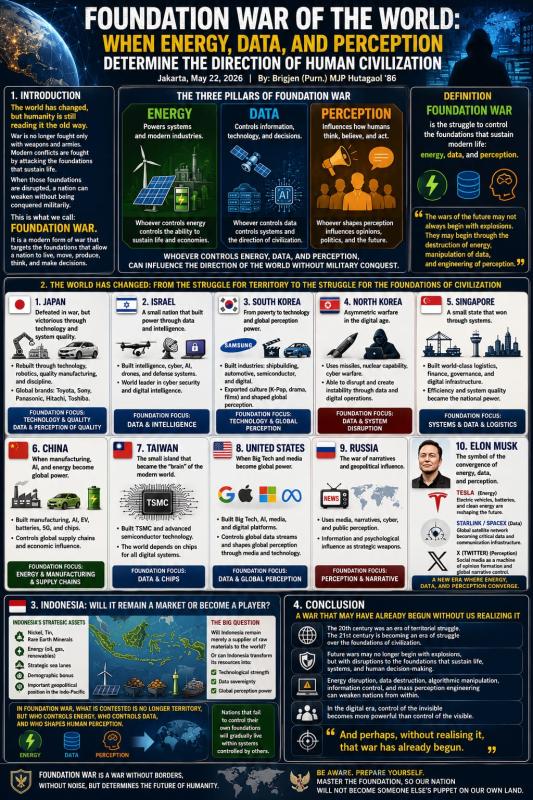
These foundations rest upon three major pillars of the modern world:
ENERGY
DATA
PERCEPTION
Whoever controls energy, data, and perception,
can gradually influence the direction of:
economics,
politics,
technology,
and even human consciousness itself.
THE WORLD HAS CHANGED:
FROM THE STRUGGLE FOR TERRITORY TO THE STRUGGLE FOR THE FOUNDATIONS OF CIVILIZATION
The 20th century was filled with major wars.
The world witnessed:
World Wars,
the Cold War,
oil conflicts,
territorial struggles,
and nuclear arms races.
But after those great conflicts,
the direction of civilization slowly changed.
The strength of nations was no longer determined solely by territory size or military numbers.
Instead,
it became determined by the ability to understand the future.
Countries once devastated,
poor,
or defeated in war,
eventually rose again because they understood a major shift in civilization.
They recognized one fundamental reality:
the future would no longer be determined only by who possesses the largest military force.
But by who can master:
ENERGY,
DATA,
and PERCEPTION.
JAPAN:
DEFEATED IN WAR, BUT VICTORIOUS THROUGH TECHNOLOGY AND SYSTEM QUALITY
Japan lost the war in 1945.
Hiroshima and Nagasaki were destroyed by atomic bombs.
Its economy collapsed.
Its industries were devastated.
Its people suffered greatly.
But Japan realized:
it could never become a world power again merely through physical warfare.
So Japan rebuilt itself through:
technology,
robotics,
precision engineering,
industrial quality,
and national discipline.
Companies such as:
Toyota,
Sony,
Panasonic,
Hitachi,
and Toshiba emerged as global symbols of excellence.
Japan eventually influenced the world not through colonization,
but through:
technology,
quality,
and global perception.
The phrase:
“Made in Japan”
became a symbol of reliability and precision.
Japan understood that control over DATA and the PERCEPTION of quality could become a global source of power.
ISRAEL:
A SMALL NATION THAT BUILT POWER THROUGH DATA AND INTELLIGENCE
Israel was established in 1948.
Small territory.
Constant conflict.
Heavy geopolitical pressure.
Israel realized:
a small nation could not survive through military numbers alone.
Therefore, Israel invested heavily in:
intelligence,
cyber capabilities,
AI,
drones,
startups,
and advanced defense systems.
Israel built one of the world’s strongest ecosystems in:
cyber security,
digital intelligence,
and military technology.
Israel understood:
whoever controls DATA and information,
can survive even under intense geopolitical pressure.
SOUTH KOREA:
FROM POVERTY TO TECHNOLOGY AND GLOBAL PERCEPTION POWER
South Korea was once devastated by the Korean War.
But South Korea quickly understood the changing direction of the modern world.
It developed:
education,
technology,
shipbuilding,
automotive industries,
semiconductors,
and digital industries.
Global companies emerged such as:
Samsung,
Hyundai,
LG,
and Kia.
But South Korea did not only export products.
It also exported:
films,
music,
digital media,
and culture through K-Pop.
South Korea eventually mastered not only manufacturing,
but also GLOBAL PERCEPTION.
The world began buying not only Korean products,
but Korean culture,
lifestyle,
and modern identity.
NORTH KOREA:
ASYMMETRIC WARFARE IN THE DIGITAL AGE
North Korea demonstrates another form of modern conflict.
Despite limited economic power,
it continues influencing global geopolitics through:
missiles,
nuclear capabilities,
cyber warfare,
and digital operations.
North Korea shows that modern warfare no longer always requires massive economic strength.
But rather the ability to disrupt:
DATA,
PERCEPTION,
and global stability.
Modern conflict is gradually shifting:
from destruction warfare to system disruption warfare.
SINGAPORE:
A SMALL STATE THAT WON THROUGH SYSTEMS
Singapore gained independence in 1965.
Small territory.
Minimal natural resources.
But Singapore understood that the modern world is controlled by:
logistics,
finance,
data,
and system efficiency.
Therefore, Singapore invested in:
modern ports,
international airports,
financial systems,
digital governance,
and global data infrastructure.
Singapore eventually became one of the world’s most important economic and logistics hubs.
It proved that in the modern era,
system quality and human efficiency can be more important than territorial size.
CHINA:
WHEN MANUFACTURING, AI, AND ENERGY BECOME GLOBAL POWER
China was once far behind.
But after economic reforms,
China realized that the future would be determined by:
manufacturing,
AI,
energy,
rare earth minerals,
and global supply chains.
China developed:
Huawei,
BYD,
Tencent,
Alibaba,
AI industries,
electric vehicles,
battery industries,
and advanced manufacturing systems.
China understood:
whoever controls modern manufacturing and energy systems,
can influence the global economy without direct war.
Today the world increasingly depends on:
Chinese manufacturing,
battery systems,
supply chains,
and technology ecosystems.
China did not merely build factories.
China built a global system of economic influence.
TAIWAN:
THE SMALL ISLAND THAT BECAME THE “BRAIN” OF THE MODERN WORLD
Taiwan is geographically small.
But Taiwan understood:
the future world would depend on semiconductors.
Therefore Taiwan built:
TSMC,
chip manufacturing,
and advanced microprocessor technology.
Today almost all:
AI systems,
servers,
smartphones,
and modern defense systems
depend on semiconductor chips.
Without chips,
the digital world could collapse.
Taiwan has therefore become one of the most strategic centers in the global struggle for DATA and technology dominance.
The world increasingly realizes:
chips today are as strategic as oil was in the last century.
THE UNITED STATES:
WHEN BIG TECH AND MEDIA BECOME GLOBAL POWER
The United States realized early that the modern world would no longer be controlled solely by tanks and aircraft carriers.
Therefore America built:
Hollywood,
Big Tech,
AI,
global media,
and digital platforms.
Companies such as:
Google,
Microsoft,
Apple,
Meta,
Amazon,
NVIDIA,
OpenAI,
and Tesla
became global technological powers.
America understood:
whoever controls global DATA and PERCEPTION,
can influence the direction of the world without always deploying military force.
Hollywood shaped global imagination.
Social media shaped global opinion.
AI began reading global human behavior.
America ultimately built not only weapons,
but systems of global influence.
RUSSIA:
THE WAR OF NARRATIVES AND GEOPOLITICAL INFLUENCE
Russia demonstrates another dimension of modern warfare.
Through various global conflicts,
Russia has shown that:
media,
narratives,
cyber operations,
and public perception
can significantly influence geopolitics.
Russia understands that PERCEPTION itself can become a strategic instrument of global power.
Modern conflict today is therefore no longer merely a war of tanks and missiles.
It is also a war of:
information,
algorithms,
and mass psychology.
ELON MUSK:
THE SYMBOL OF ENERGY, DATA, AND PERCEPTION CONVERGENCE
In the midst of these global changes,
Elon Musk becomes a fascinating symbol of the modern age.
Not merely because of his wealth,
but because the companies he built operate directly within the three major pillars of modern civilization.
Tesla operates in ENERGY.
Electric vehicles,
battery systems,
AI-driven mobility,
and renewable energy ecosystems
are gradually reshaping the future of industry.
Starlink through SpaceX operates in DATA and global communications.
Satellites today are no longer merely communication tools.
They have become:
global data infrastructure,
strategic communication systems,
and part of the struggle for modern information control.
X/Twitter operates in PERCEPTION.
Social media today is no longer simply a communication platform.
It has become:
a machine of opinion formation,
a battlefield of narratives,
and an instrument shaping global perception.
Elon Musk therefore symbolizes a new era:
when ENERGY,
DATA,
and PERCEPTION
begin converging within one massive digital civilization ecosystem.
INDONESIA:
WILL IT REMAIN A MARKET OR BECOME A PLAYER?
Where does Indonesia stand in this transformation?
Indonesia actually possesses some of the world’s most strategic foundations.
Indonesia has:
nickel,
tin,
rare earth minerals,
energy resources,
strategic sea lanes,
demographic advantages,
and an important geopolitical position in the Indo-Pacific region.
Indonesia gained independence in 1945,
earlier than many nations that later became technological powers.
But the question remains:
Will Indonesia remain merely a supplier of raw materials to the world?
Or can Indonesia transform its national resources into:
technological strength,
data sovereignty,
and global perception power?
Because in Foundation War,
what is being contested is no longer merely territory.
But:
who controls energy,
who controls data,
and who shapes human perception.
Because nations that fail to control their own foundations,
will gradually live within systems controlled by others.
CONCLUSION
A WAR THAT MAY HAVE ALREADY BEGUN WITHOUT US REALIZING IT
The 20th century was an era of territorial struggle.
But the 21st century is gradually becoming an era of struggle over the foundations that allow humanity to:
live,
move,
think,
and make decisions.
Future wars may no longer begin with explosions.
They may begin through:
energy disruption,
data destruction,
algorithmic manipulation,
information control,
and mass perception engineering.
And perhaps,
without realizing it,
that war has already begun.
Jakarta, May 22, 2026
Brigjen (Ret.) MJP Hutagaol ‘86
TAGS : Brigjen Purn MJP Hutagaol