FROM READING THE STARS TO STAR WARS
FROM READING THE STARS TO STAR WARS
Reporter: luska
Redaktur: Rikard Djegadut
When the Sky That Once Guided CivilizationIs Now Slowly Becoming a Battleground for Global Power
Jakarta, 24 May 2026
By: Brigadier General (Ret.) MJP Hutagaol ‘86’
INTRODUCTION
Since the dawn of civilization, humanity has always looked to the sky with awe.
Long before the internet,long before electricity,and even before the existence of modern nation-states,human beings had already learned to read the stars.
The sky became:a compass,a calendar,a navigation system,a spiritual symbol,and part of humanity’s search for meaning itself.
Ancient Egyptians observed the stars to align pyramids and organize the rhythms of their civilization.
The Romans used constellations for navigation, maritime expansion, and imperial power.
The Maya civilization developed remarkably advanced astronomical knowledge for its time.
Ancient Chinese philosophy viewed the heavens as part of the cosmic balance between humanity and nature.
In Japanese tradition, the sun itself became a national symbol, reflected in the phrase:“The Land of the Rising Sun.”
Across many spiritual traditions, the sky was often seen as a bridge between humanity and a higher power.
In Christianity, the Star of Bethlehem symbolizes guidance toward the birth of Jesus Christ.
In Islam, the Isra and Mi’raj represents the spiritual journey of Prophet Muhammad SAW, regarded by Muslims as one of the profound moments in the history of faith.
In other words,from the very beginning,humanity never saw the sky as empty space.
The sky represented:direction,hope,knowledge,power,and mystery.
THE NUSANTARA CIVILIZATION AND THE SKY
In the Nusantara archipelago, humanity’s relationship with the sky also has deep historical roots.
Ancient Bugis, Makassar, and Nusantara sailors navigated vast oceans by reading the stars long before modern GPS technology existed.
They understood winds, currents, seasons, and constellations through knowledge passed down across generations.
In Javanese tradition, Pranata Mangsa reflected an understanding of the relationship between seasons, nature, humanity, and the sky.
In Batak cosmology, the concepts of Banua Ginjang, Banua Tonga, and Banua Toru describe the interconnected relationship between the heavens, the human world, and the underworld.
These traditions reveal that Nusantara civilizations did not view the sky merely as empty space,but as part of cosmic balance and the order of existence itself.
It reminds us that civilizations across the world, including Nusantara, once understood that humanity is not the center of the universe,but only a small part of a far greater cosmic order.
FROM THE SPIRITUAL SKY TO THE TECHNOLOGICAL SKY
For thousands of years, humanity looked at the sky with limitations.
Then science changed everything.
Galileo Galilei became one of the great symbols of that transformation.
Through the telescope, humanity began to observe the heavens not only through myth and imagination,but through scientific understanding.
From that moment onward,humanity’s perception of the universe changed forever.
The sky was no longer merely a spiritual symbol.
It became a domain to be studied, explored, and eventually controlled.
Scientific revolutions gave birth to modern navigation, astronomy, rocketry, and eventually the space age itself.
When the Soviet Union launched Sputnik in 1957,the world realized that outer space was no longer only a scientific frontier.
It had become an arena of geopolitical competition.
The United States responded through NASA,and the Space Race began.
From that moment forward,the sky slowly transformed into part of the architecture of global power.
WHEN HUMANITY TOUCHED THE SKY
The symbolic peak of that transformation came in 1969,when humanity landed on the Moon through the Apollo mission.
For the first time in history,human beings did not merely observe the sky.
They stepped beyond Earth itself.
That moment fundamentally changed human psychology.
Humanity began to believe that no frontier was impossible.
Yet history also teaches another lesson:
every new domain reached by humanity eventually becomes a domain of competition and power.
Oceans were contested.Trade routes were contested.Energy resources were contested.Data is contested today.
And now,outer space is slowly moving in the same direction.
THE SKY IS NO LONGER NEUTRAL
Today, thousands of satellites orbit the Earth.
Some support communication.Some enable navigation.Some monitor weather.Some provide global internet access.
Others, however, are part of modern military and intelligence systems.
Without satellites:GPS systems could fail,drones could lose direction,military communications could collapse,navigation systems could malfunction,and the global digital economy itself could be disrupted.
In other words,the modern sky is no longer empty space.
It has become part of the infrastructure of modern civilization.
In the past,humanity looked to the sky with gratitude and curiosity.
Today,humanity increasingly views the sky through the lens of strategic competition, technological rivalry, and geopolitical influence.
The sky that once guided civilizationis slowly becoming part of the architecture of modern power.
THE EMERGENCE OF MODERN STAR WARS
In the past, nations built fortresses on land.
Today, global powers are building “orbital fortresses.”
The United States established the Space Force.
China accelerated its space station and satellite programs.
Russia strengthened hypersonic missile systems and electronic warfare capabilities.
Private corporations such as SpaceX, led by Elon Musk, are now building space-based infrastructures capable of influencing global communication through satellite systems like Starlink.
Humanity is no longer merely reading the sky.
Humanity is beginning to build civilization within the sky itself.
Artificial Intelligence is now capable of processing military-scale data within seconds.
Modern warfare is no longer defined only by tanks, warships, and fighter jets.
It is increasingly defined by:satellites,AI,data,cyber warfare,drone swarms,and orbital dominance.
WHEN AI ENTERS THE SKY
Artificial Intelligence is no longer simply a digital tool.
AI is now used to:analyze battlefield patterns,coordinate drones,support missile defense systems,process massive amounts of data,and simulate global strategic scenarios.
Human decision-making is now increasingly combined with machine-speed computation.
For the first time in history,humanity is creating systems that may eventually surpass human analytical capabilities in certain domains.
And this raises a profound question:
Is humanity still controlling technology?
Or is humanity slowly being directed by the systems it created itself?
FOUNDATION WARFARE IN SPACE
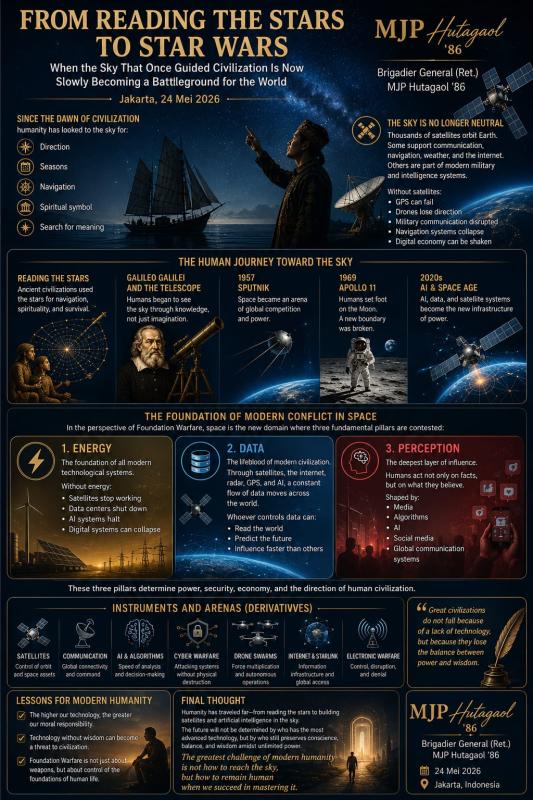
From the perspective of Foundation Warfare,outer space is not merely a new technological frontier.
It is becoming the battleground for the three fundamental pillars of modern civilization:
ENERGY,DATA,and PERCEPTION.
Energy remains the foundation of all technological systems.
Without energy:satellites fail,data centers shut down,AI systems stop functioning,and digital civilization itself can collapse.
Data has become the nervous system of modern civilization.
Through satellites, internet networks, radar systems, GPS, and AI,humanity now lives inside an uninterrupted flow of global data.
Whoever controls datagains the ability to read, predict, and influence the world faster than others.
Yet the deepest layer is perception.
Because human beings do not act solely based on facts,but based on what they believe to be true.
Media,algorithms,AI,social platforms,and global communication systems increasingly shape humanity’s perception of reality itself.
This is where Foundation Warfare enters a new era.
No longer merely a struggle over territory on Earth,but a struggle over the foundations that shape the direction of human civilization.
LESSONS FOR MODERN HUMANITY
This discussion is not intended to spread fear.
It is intended to remind humanity that the greater our technological power becomes,the greater our moral responsibility must become as well.
History repeatedly shows that humanity often succeeds in creating technology,but fails to control its own ambition.
Nuclear technology became atomic weapons.
Social media connected humanity,but also divided it.
Artificial Intelligence was created to assist humanity,yet it may eventually shape how humanity itself thinks.
And outer space,once seen as a symbol of hope and exploration,is slowly becoming an arena of strategic domination.
Great civilizations do not collapse because they lack technology.
They collapse because they lose the balance between power and wisdom.
Perhaps humanity’s greatest modern challenge is not failing to reach the sky.
But forgetting wisdom after finally reaching it.
CONCLUSION
Humanity’s journey from reading the stars to Star Wars is ultimately the story of civilization itself.
Human beings have evolved from navigating oceans through constellationsto building satellites and artificial intelligence in the sky.
Yet history continues to remind us:
every technological leap without moral balance can eventually become a threat to civilization itself.
In the end,the future of the world may not be determined by who possesses the most advanced technology.
But by who still possesses:conscience,balance,wisdom,and humanity itself amidst unlimited power.
And perhaps…
the greatest challenge of modern civilization is no longer how to reach the sky.
But how to remain human after mastering it.
Because the sky will always remain a mirror.
Not merely to measure how far humanity can fly.
But to ask whether humanity still remembers the way home.
Brigadier General (Ret.) MJP Hutagaol ‘86’