FOUNDATION WAR AND GLOBAL FOOD SECURITY
FOUNDATION WAR AND GLOBAL FOOD SECURITY
Reporter: luska
Redaktur: Rikard Djegadut
When Farmland, Data, AI, and Human Capital Become the Battlefield of the Future
By Brigjen (Ret.) MJP Hutagaol
INTRODUCTION: WAR IS MOVING TOWARD THE FOUNDATIONS OF LIFE
Modern warfare continues to evolve.
In the past, nations fought over territory.After the industrial revolution, global competition shifted toward energy: oil, gas, shipping lanes, and strategic natural resources.
Today, however, the world is moving even deeper.
Global attention is increasingly shifting toward one fundamental element that determines human survival:food.
Amid the rise of Artificial Intelligence (AI), climate uncertainty, geopolitical tension, and population growth, food is no longer merely an agricultural issue.
Food is becoming part of the architecture of global power.
Because ultimately, those who control food systems will possess significant influence over social stability, economic resilience, and the direction of nations.
THE WORLD IS BEGINNING TO VIEW FOOD AS STRATEGIC POWER
Recent global developments reveal a major structural shift.
Technology billionaires once associated with software, social media, cloud computing, and digital platforms are now moving aggressively into agriculture and productive land ownership.
Bill Gates, for example, became one of the largest private farmland owners in the United States, holding more than 240,000 acres of agricultural land.
Jeff Bezos has invested in advanced agricultural technologies and high-efficiency farming systems.
Jack Ma has promoted smart farming ecosystems through cloud computing, weather analytics, and AI-driven agricultural management.
Meanwhile, major global corporations are investing heavily in precision agriculture, AI farming, satellite monitoring, and food supply-chain intelligence systems.
The question is:why are technology elites moving into agriculture?
The answer is simple:because the world increasingly understands that food is the foundation of human civilization.
MODERN FOOD SYSTEMS NO LONGER STAND ALONE
Traditional agriculture once depended primarily on land, water, and human labor.
Modern agriculture is different.
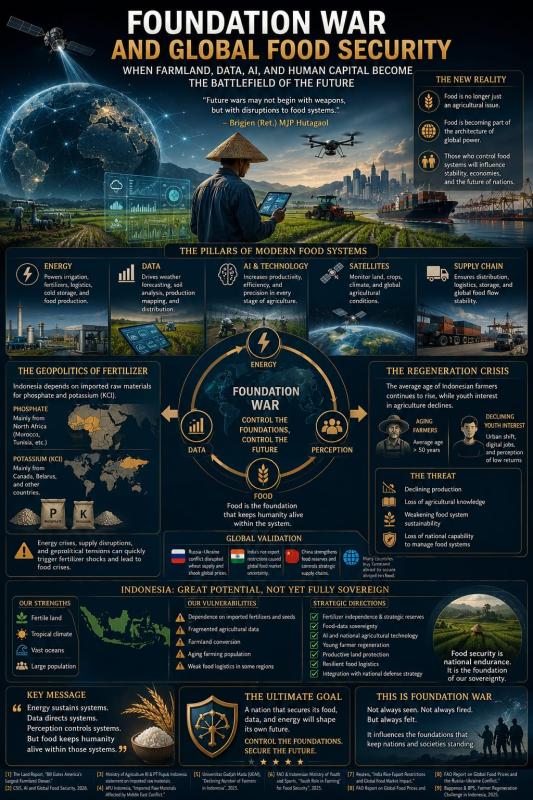
Today’s food systems depend on:
energy for irrigation, fertilizer production, logistics, and cold storage,
data for weather prediction, soil analysis, production mapping, and distribution management,
AI for efficiency and productivity,
satellites for monitoring agricultural conditions,
and digital infrastructure for controlling global supply chains.
This means:
food security is no longer isolated from technology and geopolitics.
It is now deeply interconnected with:energy,data,technology,logistics,and public perception.
This is where the concept of Foundation War becomes increasingly relevant.
FOUNDATION WAR: FOOD ENTERS THE GLOBAL SYSTEM OF CONTROL
Foundation War refers to a modern form of strategic competition aimed not merely at destroying nations physically, but at controlling the foundations that sustain national systems:energy,data,and perception.
In today’s evolving landscape, food is becoming an integral part of this structure.
Because modern food systems cannot function without:
ENERGY
Without energy:
irrigation stops,
fertilizer production weakens,
logistics collapse,
and cold storage systems fail.
DATA
Without data:
weather patterns become unpredictable,
production becomes inefficient,
distribution becomes unstable,
and supply chains become vulnerable.
PERCEPTION
When food scarcity narratives spread:
panic buying emerges,
prices surge,
and social stability becomes fragile.
Food therefore is not merely about consumption.
It is about national resilience.
THE GEOPOLITICS OF FERTILIZER: A HIDDEN VULNERABILITY
Indonesia remains relatively strong in urea production due to domestic gas resources.
However, major vulnerabilities remain in phosphate and potassium (KCl) raw materials, which still depend heavily on imports.
Phosphate largely comes from North African countries such as Morocco and Tunisia.
Potassium imports rely heavily on Canada, Belarus, and several other suppliers.
This means:
Indonesia may possess fertile land and farmers,but part of its food-production foundation still depends on global supply chains.
Under normal conditions, this dependency may appear manageable.
But during geopolitical conflict, supply disruptions, energy shocks, or global trade instability, fertilizer prices can rise sharply and directly affect food production costs.
This demonstrates a critical reality:
energy crises can quickly evolve into food crises.
Because modern agriculture depends heavily on:
energy,
global logistics,
and geopolitical stability.
THE REGENERATION CRISIS: A SLOWLY EMERGING THREAT
One of Indonesia’s most serious long-term challenges is the aging agricultural workforce.
Research shows that the average age of Indonesian farmers continues to rise, while younger generations increasingly avoid agricultural and livestock sectors.
This issue is not merely about aging demographics.
It reflects a deeper structural problem:the weakening regeneration of national food-system human capital.
Many young people now prefer urban industries, digital sectors, and service economies over agriculture, which is often viewed as physically demanding, economically uncertain, and socially unattractive.
Yet long-term food security depends not only on land,but also on the people capable of managing it.
If regeneration fails,the future threat will not only be declining production,but also the gradual loss of agricultural knowledge, experience, and strategic capability.
This problem is now appearing not only in farming,but also in livestock and broader food-production systems.
In the context of Foundation War, this becomes highly strategic.
Because a nation may still possess:
land,
water,
and natural resources,
while slowly losing the human capacity required to sustain them.
GLOBAL VALIDATION: FOOD IS BECOMING A STRATEGIC BATTLEGROUND
Recent global events clearly validate this trend.
The Russia–Ukraine conflict demonstrated how wheat disruptions could affect global food prices and destabilize international markets.
India’s restrictions on rice exports created significant anxiety across Asian food markets and global supply chains.
China continues strengthening food reserves and strategic supply-chain control.
Several Middle Eastern countries are acquiring agricultural land abroad to secure long-term food access.
These developments reveal a common pattern:
states and global elites increasingly view food as a strategic instrument of power.
INDONESIA: GREAT POTENTIAL, BUT NOT YET FULLY SOVEREIGN
Indonesia possesses extraordinary advantages:fertile land,tropical climate,vast oceans,and a large population.
However, major vulnerabilities remain.
Dependence on:
fertilizer imports,
agricultural technology,
food logistics,
strategic data systems,
and seed ecosystems
continues to challenge national resilience.
Agricultural data remains fragmented.Farmland conversion continues.And the farming population continues aging.
Therefore, food security can no longer be understood merely as the ability to grow crops.
Indonesia must begin building:
food-data sovereignty,
national agricultural technology systems,
strategic fertilizer resilience,
AI-based agricultural infrastructure,
logistics resilience,
and regeneration of modern young farmers and livestock producers.
Because in the future:
nations that fail to control food data may struggle to control food stability itself.
NATIONAL RESILIENCE IN THE ERA OF FOUNDATION WAR
Modern national strength is no longer determined solely by military size or territorial scale.
It increasingly depends on the ability to integrate and control the foundations that sustain civilization.
Data only becomes strategic when transformed into:
policy direction,
national resilience,
and long-term survival capability.
This is why integrating:energy,food,data,technology,and perception
has become part of modern national defense.
Foundation War does not always destroy nations openly.
Instead, it gradually influences the foundations that keep societies functioning from within.
INDONESIA’S STRATEGIC DIRECTION
Indonesia must move beyond simply increasing agricultural production.
The country must also strengthen:
strategic fertilizer independence,
food-data sovereignty,
agricultural technology development,
AI-driven farming systems,
young farmer regeneration,
productive land protection,
and resilient food logistics systems.
This effort cannot rely solely on one ministry or institution.
It requires integration between:government,universities,industry,technology sectors,local communities,and national strategic institutions.
Because food security is not merely an economic issue.
It is national endurance.
CONCLUSION: FOOD AS THE FOUNDATION OF CIVILIZATION
The world is changing.
Energy remains critical.Data increasingly shapes decisions.Perception influences stability.
But above all,human beings still require food to survive.
This means future conflicts may not begin with weapons,but with disruptions to the systems that sustain human life itself.
In this context:
Foundation War is no longer only about energy, data, and perception.
It is also about who can keep society alive within their own system.
And nations that fail to secure food sovereignty may gradually lose the ability to determine their own future.
KEY STATEMENTS
“Future wars may not begin with weapons, but with disruptions to food systems.”
“Food is no longer merely a necessity of life, but part of the architecture of global power.”
“Energy sustains systems.Data directs systems.Perception controls systems.But food keeps humanity alive within those systems.”
“A nation that fails to secure food sovereignty may not collapse immediately, but may slowly lose control over its own destiny.”
Jakarta, 19 May 2026
Brigjen (Ret.) MJP Hutagaol
CATATAN KAKI
[^1]: The Land Report, “Bill Gates America’s Largest Farmland Owner.”
"landreport.com" (https://reference-url-citation.invalid/0)
[^2]: CSIS, AI and Global Food Security, 2026.
"csis.org" (https://reference-url-citation.invalid/1)
[^3]: Kementerian Pertanian RI dan PT Pupuk Indonesia menyebut bahwa bahan baku pupuk phosphor (P) dan kalium (KCl) nasional masih bergantung pada impor karena keterbatasan cadangan domestik.
[^4]: AFU Indonesia, “Bahan Baku Impor Terdampak Konflik Timur Tengah, Pemerintah Percepat Subsidi Pupuk.”
"afu.id" (https://reference-url-citation.invalid/2)
[^5]: Universitas Gadjah Mada (UGM), “Declining Number of Farmers in Indonesia”, 2025.
"ugm.ac.id" (https://reference-url-citation.invalid/3)
[^6]: FAO dan Kementerian Pemuda dan Olahraga RI, “Youth Role in Farming for Food Security”, 2025.
"jatim.antaranews.com" (https://reference-url-citation.invalid/4)
[^7]: Reuters, “India Rice Export Restrictions and Global Food Market Impact.”
"reuters.com" (https://reference-url-citation.invalid/5)
[^8]: FAO Report on Global Food Prices and Ukraine Conflict.
[^9]: Bappenas & BPS, Farmer Regeneration Challenge in Indonesia, 2025.
"journal.pusbindiklatren.bappenas.go.id" (https://reference-url-citation.invalid/6)