
FOUNDATION WARFARE IN THE 21ST CENTURY
FOUNDATION WARFARE IN THE 21ST CENTURY
Reporter: luska
Redaktur: Rikard Djegadut
When Energy, Data, and Perception Become the Battleground of Nations, Corporations, and Individuals
Jakarta, June 5, 2026
By: Brigadier General (Ret.) MJP Hutagaol '86'
INTRODUCTION
THE WORLD IS CHANGING, BUT MANY STILL READ IT THROUGH AN OLD LENS
The world is changing.
The transformation is unfolding at an extraordinary pace, yet it is not always visible to the naked eye. As a result, many people continue to interpret global events through outdated perspectives while the world itself has already moved in a different direction.
Most people still understand war as the clash of armies, territorial invasions, military campaigns, or open struggles for power.
Yet history shows that the nature of warfare has continuously evolved alongside human civilization.
In ancient times, wars were primarily fought to seize territory. The larger the territory, the greater the power of a kingdom.
Later, warfare evolved into competition for trade routes. European powers competed to control ports, strategic straits, and commercial centers because they understood that whoever controlled trade controlled wealth, and whoever controlled wealth possessed power.
With the arrival of the Industrial Revolution, warfare changed again. Coal, steel, machinery, and industrial capacity became the foundations of national strength. The First and Second World Wars demonstrated how industrial capability could determine victory or defeat.
The world then entered the age of energy. Oil became the lifeblood of the global economy. It is therefore unsurprising that many major conflicts throughout the twentieth century and the early twenty-first century occurred in regions rich in energy resources.
The twenty-first century, however, has introduced a far more profound transformation.
Today, what is being contested is no longer merely territory, trade routes, industry, or even oil itself.
What is being contested are the foundations that sustain modern civilization.
These foundations form what this paper describes as Foundation Warfare.
Foundation Warfare is not always visible.
It does not always begin with gunfire.
It does not always take the form of military invasion.
Yet its consequences may determine the future of entire nations.
Within this perspective, modern civilization rests upon three fundamental pillars:
Energy.
Data.
Perception.
Energy powers economic and social life.
Data shapes knowledge and decision-making.
Perception influences how people think, believe, and act.
Whoever can influence or control these three pillars will possess tremendous influence over the direction of the world.
VOC AND THE EAST INDIA COMPANY:WHEN CORPORATIONS BEGAN TO SHAPE THE WORLD
If examined more closely, this pattern is not entirely new.
During the seventeenth and eighteenth centuries, the world witnessed the rise of two corporations whose influence exceeded that of many states of their time.
The first was the Dutch East India Company (VOC) in the Indonesian archipelago.
The second was the British East India Company in India.
Both began as commercial enterprises.
Yet over time they evolved into political, economic, and military powers.
The VOC did far more than trade spices.
It possessed warships, military forces, taxation authority, and even the power to negotiate political agreements.
The Dutch understood that the vast Indonesian archipelago could not be controlled solely through military force.
Therefore, they built more than forts.
They built systems.
They built trade networks.
They cultivated intermediary elites.
They exploited rivalries among local kingdoms.
They controlled economic distribution channels.
In other words, they controlled not merely territory, but the foundations that sustained that territory.
A similar pattern emerged in India.
The East India Company began as a trading company.
Over time, however, it became powerful enough to influence local rulers, collect taxes, control commerce, and maintain one of the largest military forces in the region.
History ultimately provides a crucial lesson:
A nation is not always controlled through military occupation.
Sometimes it can be influenced through control of the systems that sustain its existence.
THE UNITED KINGDOM:WHEN LANGUAGE BECAME A FOUNDATION OF GLOBAL POWER
If the VOC and the East India Company demonstrated the power of corporations, the United Kingdom demonstrated the power of language.
When the British Empire began to decline, many assumed British influence would decline with it.
History proved otherwise.
Today, English serves as the dominant language of business, technology, diplomacy, aviation, the internet, and scientific research.
Britain left behind something far more enduring than fleets and fortresses.
It left behind a global communication system.
Language itself became part of the foundation of perception in the modern world.
THE GLOBAL CONTEST FOR ENERGY, DATA, AND PERCEPTION
If the nineteenth century was defined by the struggle for colonies, and the twentieth century by the struggle between competing ideologies, then the twenty-first century may ultimately be remembered as the century of competition over the foundations that sustain civilization itself.
These foundations are no longer measured simply by territory or population.
They are increasingly defined by three strategic pillars:
Energy.
Data.
Perception.
These three pillars have become the new center of gravity in global affairs.
Around them operate three major categories of actors:
States.
Corporations.
Individuals.
They compete across multiple arenas, including land, sea, cyberspace, outer space, economics, and information.
To understand the modern world, therefore, it is no longer sufficient to observe only the conflicts visible on the surface.
One must also understand what is being contested beneath the surface.
RUSSIA:ENERGY AS A GEOPOLITICAL INSTRUMENT
Within the Energy pillar, Russia remains one of the world's most influential actors.
The country possesses vast reserves of natural gas, oil, uranium, and other strategic resources.
For decades, much of Europe depended heavily on Russian energy supplies.
When the Russia–Ukraine conflict escalated, its consequences extended far beyond the battlefield.
Energy prices surged.
Supply chains were disrupted.
Inflation spread across multiple economies.
These developments demonstrated that energy is far more than an economic commodity.
Energy has become a geopolitical instrument.
Those who influence energy flows possess the ability to influence entire regions.
For this reason, Russia remains a significant player in Foundation Warfare in the twenty-first century.
THE UNITED STATES:THE POWER OF DATA AND GLOBAL PERCEPTION
If Russia's strength lies primarily in energy, the United States possesses extraordinary advantages in Data and Perception.
Many of the world's largest technology companies originated and continue to thrive in the United States.
Google.
Microsoft.
Apple.
Meta.
Amazon.
OpenAI.
These organizations manage and process the data of billions of people every day.
That data is transformed into knowledge, artificial intelligence, predictive systems, business models, and new forms of influence.
At the same time, the United States maintains substantial influence over global perception.
International media networks.
Entertainment industries.
Digital platforms.
Communication infrastructures.
All contribute to America's ability to shape narratives and perceptions worldwide.
Consequently, American power extends far beyond military capability.
It is also rooted in its capacity to manage data and influence perception on a global scale.
CHINA:PURSUING ALL THREE PILLARS
If the United States dominates much of the Data and Perception landscape, while Russia remains a major Energy power, China appears to be pursuing all three pillars simultaneously.
China has built the world's largest manufacturing ecosystem.
It controls significant portions of global supply chains.
It continues to invest heavily in artificial intelligence, semiconductors, electric vehicles, telecommunications, and digital technologies.
Simultaneously, China has strengthened its energy security through international partnerships and strategic investments.
This helps explain why competition between the United States and China has become one of the defining geopolitical dynamics of our era.
The contest is no longer merely about trade.
It concerns the foundations of future civilization itself.
IRAN:GUARDIAN OF A CRITICAL ENERGY ARTERY
In the Middle East lies one of the most strategically important waterways on Earth.
The Strait of Hormuz.
A significant share of global energy trade passes through this narrow corridor.
As a result, Iran occupies a geopolitical position that far exceeds the size of its territory.
Any tension in the Hormuz region can rapidly influence global energy markets.
This demonstrates that within Foundation Warfare, certain geographic locations possess influence far beyond their physical dimensions.
Control, access, and stability can become strategic assets of immense importance.
TAIWAN:THE HEART OF THE SEMICONDUCTOR AGE
If energy serves as the lifeblood of modern civilization, semiconductors serve as its nervous system.
Virtually every modern digital device depends on advanced chips.
Smartphones.
Vehicles.
Data centers.
Satellites.
Defense systems.
Industrial automation.
Taiwan occupies a uniquely important position in this ecosystem.
Through its semiconductor industry, Taiwan has become one of the most critical nodes within the global Data pillar.
For this reason, the Taiwan issue is not merely geopolitical.
It is also deeply connected to the future of global technology, economic competitiveness, and digital infrastructure.
ISRAEL:THE POWER OF TECHNOLOGY AND INTELLIGENCE
Amid one of the world's most turbulent regions, Israel demonstrates that geographic size is not the sole determinant of national power.
Compared with many other countries, Israel is relatively small.
Yet its influence in technology, cybersecurity, intelligence, artificial intelligence, and innovation extends far beyond its territorial dimensions.
Israel understands that in the modern world, data can often be more valuable than territory.
For this reason, the country has invested heavily in education, research, defense technologies, cybersecurity, and innovation ecosystems.
From the perspective of Foundation Warfare, Israel illustrates how the Data pillar can become a strategic source of national strength.
Its experience demonstrates that human capital and technological mastery can transform limitations into advantages.
JAPAN:THE POWER OF SYSTEMS AND HUMAN QUALITY
Following the devastation of the Second World War, many observers believed Japan would require decades to recover.
Yet history unfolded differently.
Japan emerged as one of the world's leading economic and technological powers.
Its success was not built upon abundant natural resources.
Rather, it was built upon discipline, education, technology, industrial excellence, and institutional strength.
The world recognizes companies such as Toyota, Sony, Panasonic, Mitsubishi, and Hitachi not merely because of their products, but because of the systems that support them.
Within Foundation Warfare, Japan demonstrates that Energy, Data, and Perception can only be managed effectively when supported by high-quality human resources.
Japan therefore serves as an example of how a nation can rebuild itself through strong and sustainable systems.
SINGAPORE:THE STRATEGY OF A SMALL STATE
If Japan demonstrates the power of systems, Singapore demonstrates the power of strategy.
Despite its limited territory and lack of significant natural resources, Singapore has become one of Asia's leading centers for finance, logistics, trade, and data.
Singapore understood early that geographic size would not determine success in the twenty-first century.
What matters is the ability to understand global change and position oneself strategically within it.
Through efficient governance, modern infrastructure, long-term planning, and investment in human capital, Singapore has achieved an influence far greater than its physical size might suggest.
In the context of Foundation Warfare, Singapore demonstrates how strategic vision can transform limitations into competitive advantages.
BLACKROCK:WHEN CAPITAL BECOMES GLOBAL POWER
If power was once measured primarily through armies and territory, the twenty-first century has revealed new forms of influence.
One of the most notable examples is capital itself.
BlackRock represents a particularly important case.
It is not a nation.
It possesses no territory.
It commands no military force.
Yet it manages trillions of dollars in assets and maintains connections across thousands of companies operating in virtually every major sector of the global economy.
This reality demonstrates how global corporations can become influential actors within Foundation Warfare.
Their influence does not arise from formal political authority.
Instead, it emerges from their ability to shape investment flows, technological development, energy markets, and economic priorities.
Capital has evolved beyond a purely economic tool.
It has become an instrument of global influence.
ELON MUSK:AN INDIVIDUAL OPERATING ACROSS ALL THREE PILLARS
History has traditionally portrayed states as the primary actors in world affairs.
The twenty-first century, however, has witnessed the rise of individuals capable of influencing global systems on an unprecedented scale.
One of the clearest examples is Elon Musk.
Through Tesla, he operates within the Energy pillar.
Through Starlink, he operates within the Data pillar.
Through X, he operates within the Perception pillar.
This phenomenon demonstrates how technological transformation has created new opportunities for individuals to exercise influence once reserved for major states.
This does not mean that individuals replace governments.
Rather, it illustrates how the architecture of power has become increasingly complex.
States, corporations, and individuals now interact within the same strategic environment and influence one another in ways rarely seen before.
STATES, CORPORATIONS, AND INDIVIDUALS:A NEW STRATEGIC LANDSCAPE
If corporations first entered geopolitics during the era of the VOC and the East India Company, the twenty-first century has expanded that reality dramatically.
States remain the primary actors in international affairs.
Yet corporations and individuals now possess unprecedented capacities to influence Energy, Data, and Perception on a global scale.
This is precisely why Foundation Warfare has become increasingly relevant.
What is being contested today is no longer merely territory.
It is the set of foundations that sustain modern civilization itself.
Energy.
Data.
Perception.
Together, these pillars shape the strategic landscape of the twenty-first century.
READING THE MAP OF FOUNDATION WARFARE IN THE 21ST CENTURY
After examining developments across different regions of the world, a more fundamental question emerges:
How does Foundation Warfare actually operate?
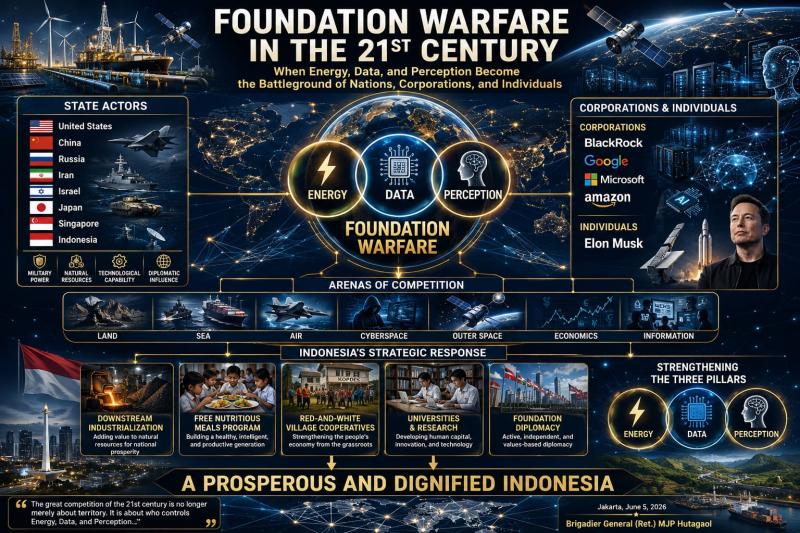
Within the framework presented in this paper, three interconnected elements define the strategic landscape of the twenty-first century:
Pillars.
Players.
Arenas.
Together, these elements form a system that shapes the competition of modern civilization.
PILLARS:WHAT IS BEING CONTESTED?
The pillars represent the foundations being contested.
Within this framework, there are three primary pillars:
Energy.
Data.
Perception.
Energy powers economies, industries, transportation systems, and daily life.
Data drives knowledge, technology, artificial intelligence, and decision-making.
Perception shapes beliefs, public opinion, social behavior, and political legitimacy.
If territory was the central objective of many wars in the past, the twenty-first century increasingly revolves around influence over Energy, Data, and Perception.
These three pillars now sustain the architecture of modern civilization.
PLAYERS:WHO IS PLAYING?
In previous centuries, states were the dominant actors in world affairs.
Today, however, new actors have emerged alongside them.
States.
Corporations.
Individuals.
The United States, China, Russia, Iran, Israel, Japan, and Indonesia represent state actors.
BlackRock illustrates the growing influence of corporations through capital, investment networks, and economic reach.
Elon Musk demonstrates how an individual can operate strategically across Energy, Data, and Perception simultaneously.
Power is no longer concentrated exclusively in governments.
Corporations and individuals now possess unprecedented capacities to influence global developments.
ARENAS:WHERE DOES COMPETITION TAKE PLACE?
Arenas are the spaces where competition unfolds.
Land.
Sea.
Air.
Cyberspace.
Outer Space.
Economics.
Information.
The Strait of Hormuz represents a critical arena within the Energy pillar.
Taiwan represents a strategic arena within the Data pillar.
Social media platforms increasingly serve as arenas within the Perception pillar.
The South China Sea remains important for trade routes, logistics, and strategic access.
Meanwhile, outer space is emerging as a new frontier through satellites, communications, navigation systems, and data infrastructure.
The battleground of the twenty-first century is therefore no longer confined to visible geography.
It increasingly extends into digital, informational, and orbital domains.
UNDERSTANDING THE WORLD THROUGH PILLARS, PLAYERS, AND ARENAS
Foundation Warfare is not intended to replace existing geopolitical, economic, or strategic theories.
Rather, it offers a framework through which contemporary global developments may be interpreted.
Through this lens, the competition between the United States and China, Russia's energy influence, Iran's position in Hormuz, Taiwan's semiconductor industry, Israel's technological capabilities, the success of Japan and Singapore, the influence of BlackRock, and the rise of Elon Musk can all be understood as components of a broader contest over Energy, Data, and Perception.
INDONESIA IN THE AGE OF FOUNDATION WARFARE
After examining how Energy, Data, and Perception are contested across the world, an important question arises:
Where does Indonesia stand?
Indonesia occupies a unique position.
It possesses significant energy resources.
Strategic minerals.
Nickel.
Tin.
Extensive maritime resources.
A large population.
And one of the most strategic geographic locations between the Indian and Pacific Oceans.
In other words, Indonesia possesses many of the ingredients necessary to become a major actor in the twenty-first century.
History, however, demonstrates that natural resources alone do not guarantee national success.
Many resource-rich nations have struggled to achieve long-term prosperity.
Meanwhile, several resource-poor countries have become global leaders through strong institutions, innovation, and human capital.
This is the challenge Indonesia must address.
BUILDING FOUNDATIONS FROM VILLAGES TO UNIVERSITIES
When viewed through the perspective of Foundation Warfare, several contemporary Indonesian policies can be interpreted as efforts to strengthen national foundations.
Downstream industrialization seeks to increase the value of national resources and reduce dependence on raw-material exports.
The Free Nutritious Meals Program represents a long-term investment in human development.
A healthier generation possesses greater capacity to learn, innovate, and compete.
The Red-and-White Village Cooperatives initiative can be understood as an effort to strengthen local economies, food distribution networks, and community resilience at the grassroots level.
At the same time, educational partnerships, research cooperation, and engagement with leading universities around the world reflect an understanding that future competitiveness depends not only on natural resources but also on knowledge, technology, and innovation.
During overseas visits, including engagements with leading British universities, discussions have extended beyond trade and investment to include research collaboration, human-capital development, technological advancement, and innovation.
If downstream industrialization strengthens the Energy pillar, universities, research, innovation, and technology strengthen the Data pillar.
Meanwhile, national unity, civic values, public trust, and collective confidence strengthen the Perception pillar.
Viewed together, these initiatives may be interpreted as efforts to strengthen all three foundations simultaneously.
PRABOWO AND FOUNDATION DIPLOMACY
In recent years, President Prabowo Subianto has actively engaged with countries across Asia, Europe, the Middle East, the Americas, ASEAN, and BRICS.
Many observers view these engagements primarily as conventional diplomacy.
Yet from the perspective of Foundation Warfare, they may also be understood as efforts to position Indonesia within an evolving global architecture.
Diplomacy is no longer solely about state-to-state relations.
It is increasingly about access to technology.
Knowledge.
Innovation.
Strategic partnerships.
And national resilience.
In this sense, diplomacy becomes part of the broader effort to strengthen national foundations in an increasingly interconnected world.
CONCLUSION
THE FUTURE OF NATIONS IN THE AGE OF FOUNDATION WARFARE
If the nineteenth century was defined by the contest for colonies, and the twentieth century by the contest of ideologies, then the twenty-first century may be remembered as the age of competition over Energy, Data, and Perception.
This competition involves states.
Corporations.
And individuals.
It unfolds across land, sea, cyberspace, outer space, economics, and information.
The United States.
China.
Russia.
Iran.
Israel.
Taiwan.
Japan.
Singapore.
BlackRock.
Elon Musk.
And many others.
Within this changing landscape, Indonesia faces a choice.
To remain a spectator.
Or to become a participant.
That choice will not be determined by slogans or natural resources alone.
It will be determined by the nation's ability to build and strengthen its own foundations.
Ultimately, Indonesia's future may depend less on the resources beneath its soil than on its ability to transform resources into Energy, knowledge into Data, and unity into Perception capable of mobilizing national strength.
Nations that master Energy, Data, and Perception will possess greater freedom to shape their own futures.
Those that fail to build their foundations may gradually find themselves operating within foundations designed by others.
Jakarta, June 5, 2026
Brigadier General (Ret.) MJP Hutagaol
REFERENCES AND NOTES
[1] William Dalrymple, The Anarchy: The Relentless Rise of the East India Company, Bloomsbury Publishing, 2019.
[2] During its peak period in the eighteenth century, the British East India Company maintained an estimated military force of approximately 260,000 personnel in India.
[3] Historical records of the Dutch East India Company (VOC), 1602–1799, widely regarded as one of the most influential commercial corporations in world history.
[4] English remains the dominant language of international aviation, scientific publications, diplomacy, global business, information technology, and internet communication.
[5] Taiwan plays a critical role in the global semiconductor ecosystem through companies such as Taiwan Semiconductor Manufacturing Company (TSMC).
[6] The Strait of Hormuz is one of the world's most strategic energy corridors, serving as a major route for global oil and gas transportation.
[7] BlackRock is among the world's largest asset-management firms, overseeing trillions of dollars in global investments.
[8] Aladdin (Asset, Liability, Debt and Derivative Investment Network) is a widely used risk-management and investment-analysis platform within the global financial industry.
[9] Klaus Schwab, The Fourth Industrial Revolution, World Economic Forum.
[10] Henry Kissinger, Eric Schmidt, and Daniel Huttenlocher, The Age of AI: And Our Human Future.
[11] Publicly available reports and studies concerning artificial intelligence, digital infrastructure, satellite communications, semiconductors, and the global digital economy, 2024–2026.
[12] Public information regarding international educational partnerships, research cooperation, and university engagement involving Indonesia and leading institutions abroad.
[13] Discussions regarding downstream industrialization, food security, the Free Nutritious Meals Program, Red-and-White Village Cooperatives, and national human-capital development are interpreted in this paper through the analytical framework of Foundation Warfare.
AUTHOR'S NOTE
This paper presents Foundation Warfare as an analytical framework for understanding contemporary global competition through three strategic pillars: Energy, Data, and Perception.
It is not intended to replace existing theories of geopolitics, international relations, economics, or strategic studies.
Rather, it seeks to provide an additional perspective for interpreting the evolving dynamics of twenty-first-century civilization.