Why Modern Conflicts Always Return to Energy, Data, and Perception
By: Brigadier General (Ret.) MJP Hutagaol
Baca juga : PERANG FONDASI: KARTU JOKER ABAD KE-21
Modern warfare has changed its form. It no longer appears solely through military invasions, the sound of artillery, or tanks crossing borders. In the 21st century, war moves more silently, more fluidly, and often more difficult to recognize. Many nations do not even realize they are under attack.
It is from this reality that I see the emergence of what I call Foundation War.
Baca juga : TRUMP- XI- ELON MUSK: FOUNDATION WARFARE AND INDONESIA’S POSITION IN THE GLOBAL TRANSITION OF POWER
And the longer I observe global conflicts, the more I realize one important thing: theoretically, Foundation War behaves like a “joker card.”
Not because it is a theory that explains everything absolutely, but because its patterns of attack can emerge across almost every arena of modern life.
Baca juga : TRUMP-XI-ELON MUSK: PERANG FONDASI GLOBAL DAN POSISI INDONESIA DALAM TRANSISI DUNIA BARU
From military conflict, trade wars, and information warfare, to food crises, data breaches, and battles over public perception — all ultimately strike at the core foundations of national life: energy, data, and perception.
In card games, the joker is the most flexible card. It can change its role depending on the needs of the game.
Foundation War operates in much the same way.
In geopolitics, it appears as competition over energy: oil, gas, food, electricity, logistics, and global supply chains.
In the digital sphere, it transforms into struggles over data: algorithms, artificial intelligence, digital surveillance, and cyber warfare.
In socio-political life, it manifests as wars of perception: propaganda, media framing, social polarization, manipulation of public opinion, and the erosion of legitimacy.
In other words, modern warfare no longer primarily attacks the physical body of the state. It attacks the foundations that keep the state alive.
ENERGY: THE FOUNDATION OF PHYSICAL SURVIVAL
Without energy, a nation becomes paralyzed.
And energy is not limited to fuel and electricity. It also includes food, water, health, and the biological necessities of human life.
That is why modern conflicts often begin with disruptions in distribution systems: rising food prices, energy shortages, broken supply chains, and weakening purchasing power.
When energy is disrupted, social stability is disrupted as well.
Thus, energy warfare is no longer simply about controlling resources, but about controlling the sustainability of society itself.
DATA: THE FOUNDATION OF MODERN CONTROL
In the digital age, data has become a new form of power.
Whoever controls data can read public behavior, predict decisions, and even influence how people think.
Today, data breaches are no longer merely technical problems. They are threats to sovereignty itself.
Because from data comes narrative, from narrative comes perception, and from perception emerge political and social decisions.
PERCEPTION: THE BATTLE FOR THE SOUL OF A NATION
This is perhaps the most dangerous battlefield.
A nation may collapse not because it loses a military war, but because it loses confidence in itself.
Today, wars of perception are carried out through social media, algorithms, disinformation, propaganda, and emotional manipulation.
When public trust in the state erodes, legitimacy slowly begins to collapse.
And modern wars are often won before a single bullet is fired.
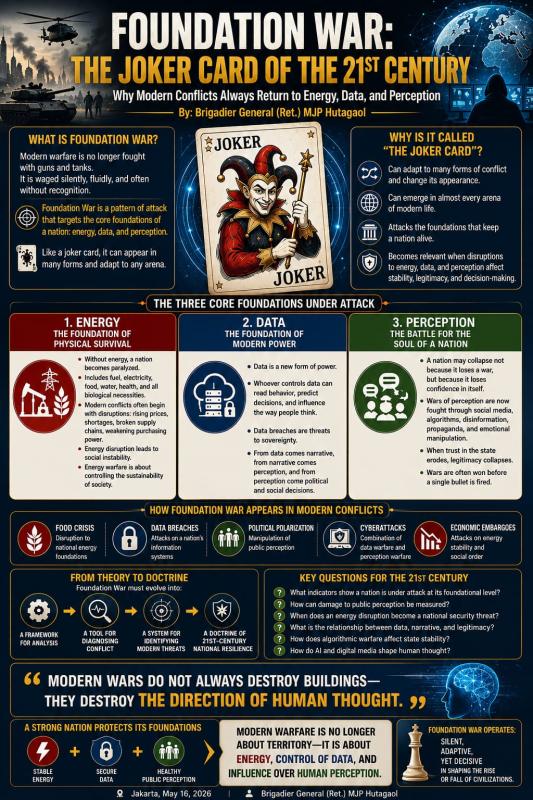
WHY IS IT CALLED “THE JOKER CARD”?
Because Foundation War can be used to understand almost every modern conflict.
A food crisis signals disruption to national energy foundations.
A large-scale data leak indicates attacks on a nation’s information systems.
Political polarization shows that public perception is being manipulated.
Cyberattacks combine both data warfare and perception warfare.
Economic embargoes are attacks on energy stability and social order.
Because of this flexibility, Foundation War behaves like a joker card: capable of entering many forms of conflict while constantly changing its appearance.
However, Foundation War does not mean that every problem automatically constitutes warfare. It becomes relevant when disruptions to energy, data, and perception begin affecting national stability, legitimacy, and strategic decision-making.
That is why Foundation War must not remain merely a grand metaphor.
It must evolve into:
a framework for analysis,
a tool for diagnosing conflict,
a system for identifying modern threats,
and ultimately, a doctrine of 21st-century national resilience.
FROM THEORY TO DOCTRINE
In the future, Foundation War must become more operational.
What indicators show that a nation is under attack at its foundational level?
How can damage to public perception be measured?
When does an energy disruption become a national security threat?
What is the relationship between data, narrative, and political legitimacy?
How does algorithmic warfare affect state stability?
How do AI and digital media shape the direction of human thought?
These questions are essential if this concept is to move beyond intellectual discourse and become applicable in:
defense,
governance,
education,
economics,
national character building,
and geopolitical strategy.
The 21st century is an era in which wars do not always destroy buildings — they destroy the direction of human thought.
A strong nation is not merely one that possesses weapons, but one that is capable of protecting its foundations:
stable energy,
secure data,
and healthy public perception.
Because modern warfare is no longer merely about territorial conquest, but about the struggle for energy, control over data, and influence over human perception.
And that is where Foundation War operates:silent,subtle,yet decisive in determining the rise and fall of civilizations.
Jakarta, May 16, 2026
Brigadier General (Ret.) MJP Hutagaol
TAGS : Brigjen Purn MJP Hutagaol