
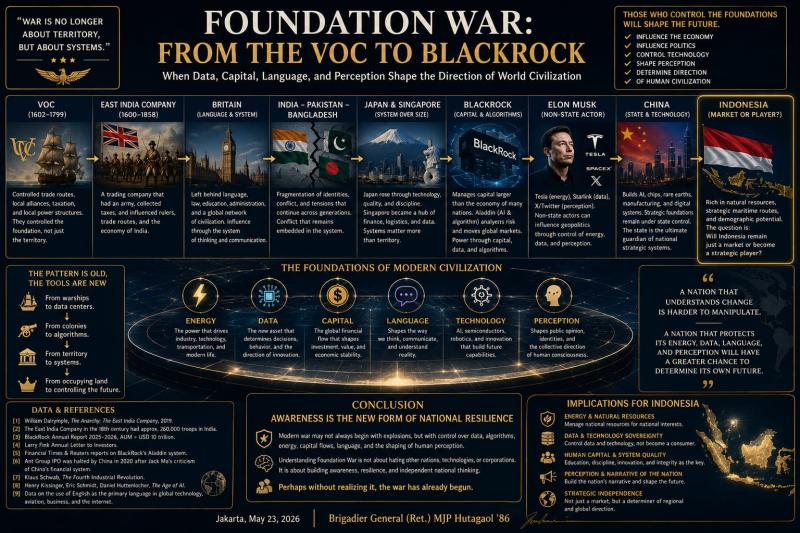
When Data, Capital, Language, and Perception Shape the Direction of World Civilization
Jakarta, May 23, 2026
Baca juga : THINKING-KETIKA DATA BELUM MENJADI PENGETAHUAN
By: Brigadier General (Ret.) MJP Hutagaol ’86
INTRODUCTION
Baca juga : SENSING-NEGARA HARUS MAMPU MENGINDERA PERUBAHAN
THE WORLD HAS CHANGED,BUT HUMANITY STILL INTERPRETS IT THROUGH OLD LENSES
Most people still perceive war as gunfire, missile strikes, tanks, or territorial conquest.
Baca juga : KETIKA MEDAN PERTAHANAN BERUBAH
Yet the modern world has undergone a far deeper transformation.
Today, war no longer always arrives through explosions and battlefields.
It has gradually shifted inward — penetrating the systems that sustain human civilization itself.
Modern civilization now stands upon foundations that are often invisible:energy that keeps systems alive,data that directs decisions,language that shapes the way societies think,and perception that moves human behavior.
When those foundations are disrupted, nations can weaken without ever being militarily invaded.
At this point emerges what may be called Foundation War.
Foundation War is not merely physical conflict.
It is the struggle over the foundations that enable nations to live, move, produce, communicate, think, and make decisions.
Today, those foundations are built upon energy, data, capital, language, technology, and perception.
Because whoever controls those foundations can gradually influence economics, politics, technology, and even the direction of human consciousness itself.
THE VOC AND THE EAST INDIA COMPANY:WHEN CORPORATIONS BEGAN TO SHAPE CIVILIZATION
If observed carefully, this pattern is not entirely new.
The VOC in the Indonesian archipelago and the British East India Company (EIC) in India were not originally states.
They began as trading corporations.
Yet over time, both evolved into powers capable of influencing the political and economic direction of entire regions.
The VOC did not merely trade spices.
It possessed armies, warships, taxation authority, and even participated in determining local rulers.
The Dutch understood one critical reality:the archipelago was too vast to be controlled solely through European military force.
Therefore, what was controlled was not merely territory.
What was controlled were the foundations of the system itself.
The Dutch cultivated intermediary elites, trade routes, economic structures, and divide-and-rule political strategies among kingdoms.
Some local rulers were not destroyed.
Instead, they were maintained and gradually directed into systems that served colonial interests.
In other words, economic foundations, distribution channels, and perceptions of power were slowly brought under control.
A similar pattern unfolded in India through the British East India Company.
It began as a commercial enterprise.
Yet eventually, the EIC commanded a military force estimated at hundreds of thousands of troops.
The company ultimately influenced local rulers, trade systems, taxation, and the broader economic direction of India.
History reveals an important reality:
large corporations are capable of influencing — even controlling — nations when economic foundations and national systems become fragile.
If colonialism once moved through warships, fortresses, and armies, the modern world increasingly moves through data, algorithms, AI, and global flows of capital.
BRITAIN:WHEN LANGUAGE BECAME A FOUNDATION OF GLOBAL POWER
Interestingly, British influence did not disappear when physical colonialism declined.
Today, Britain may no longer be the world’s largest territorial empire.
Yet the English language has become one of the principal foundations of modern civilization.
The internet, AI, global business, aviation, scientific journals, diplomacy, and digital technology largely operate in English.
This means Britain did not merely leave behind former colonies.
It left behind language, legal systems, education, administration, and global civilizational networks.
Australia, Singapore, and many other nations remain connected to the Anglo-Saxon institutional and cultural legacy.
Here we see an important reality:the greatest influence is often no longer territorial occupation,but the ability to shape how the world thinks, communicates, and interprets reality itself.
INDIA, PAKISTAN, AND BANGLADESH:CONFLICTS LEFT EMBEDDED WITHIN THE SYSTEM
India, Pakistan, and Bangladesh were once united under British India.
Yet after colonialism ended, the region fragmented into separate nations.
Until today, tensions, rivalries, and conflicts continue to endure.
This demonstrates that colonialism does not merely leave behind physical destruction.
Sometimes what remains are fractured identities, prolonged tensions, and intergenerational conflicts of perception.
This is where Foundation War becomes essential to understand.
Because modern conflict no longer merely destroys territory.
It can shape social foundations, collective thinking, and the long-term trajectory of nations themselves.
JAPAN AND SINGAPORE:WHEN SYSTEMS BECOME MORE IMPORTANT THAN TERRITORY
Japan was devastated after World War II.
Yet Japan understood that the future would no longer be determined solely by military strength.
Therefore, Japan invested in technology, robotics, industrial quality, and systemic discipline.
The world eventually came to recognize Toyota, Sony, Panasonic, and the global reputation of “Made in Japan.”
Japan demonstrated that even a defeated nation can rise again through human quality and institutional excellence.
Singapore offers another important example.
Despite its small territory and limited natural resources, it transformed itself into a financial, logistics, and data hub for Asia.
Singapore understood global transformation faster than many larger nations.
It recognized that in the modern world, system speed, efficiency, and human quality may matter more than territorial size.
This means modern Foundation War is no longer merely about who controls the largest territory.
It is about who builds the strongest systems.
BLACKROCK:WHEN CAPITAL AND ALGORITHMS BECOME GLOBAL POWER
Today, the world is witnessing the rise of a new form of power.
Not only states.
But also global corporations capable of influencing the architecture of the modern world itself.
One frequently discussed name in global finance is BlackRock.
BlackRock is not a state.
It is a global investment corporation managing enormous amounts of capital — larger than the economies of many nations.
BlackRock holds investments in major global corporations such as Apple, Microsoft, Google, Amazon, Tesla, and numerous sectors within global energy and finance.
This means modern influence no longer moves solely through military force.
It also moves through capital, algorithms, and financial data.
BlackRock also operates an AI- and algorithm-based risk analysis system known as Aladdin.
This system is used by many global financial institutions to analyze economic risk, market movement, and financial stability.
At this point, the architecture of global power itself begins to change.
If influence once moved primarily through military power, today it increasingly moves through algorithms, data, media, and capital flows.
The modern world is gradually shifting from territorial competition toward competition over systems.
ELON MUSK:NON-STATE ACTORS IN MODERN FOUNDATION WAR
The phenomenon of Elon Musk is equally significant.
Because his companies stand directly upon the core foundations of the modern world.
Tesla operates within the energy domain.
Starlink operates within global data and communication networks.
X/Twitter operates within perception and public opinion.
This means non-state actors today are capable of influencing global geopolitics through the control of energy, data, and perception.
The world is entering a new era in which global influence no longer rests entirely in the hands of states.
CHINA:THE STATE REMAINS THE GUARDIAN OF STRATEGIC FOUNDATIONS
China interprets global transformation differently.
China is building AI, semiconductor technology, manufacturing, rare earth industries, electric vehicles, and digital systems.
However, China also understands that strategic foundations cannot be entirely separated from state control.
When Jack Ma and Alibaba were perceived as becoming excessively influential over national financial systems and data structures, the Chinese government intervened aggressively.
The Ant Group IPO was suspended.
Alibaba came under regulatory investigation.
Jack Ma himself disappeared from public visibility for a period of time.
This illustrates China’s understanding that data, AI, payment systems, and strategic technologies are integral parts of national power foundations.
Therefore, China seeks to ensure that the state remains the ultimate guardian of strategic national systems.
INDONESIA:WILL IT REMAIN A MARKET — OR BECOME A STRATEGIC PLAYER?
Indonesia actually possesses enormous strategic foundations.
The nation holds nickel, tin, rare earth elements, palm oil, energy resources, strategic maritime routes, and demographic advantages.
But the central question remains:
Will Indonesia merely become a supplier of raw materials to the world?
Or can it transform national wealth into technological strength, data sovereignty, and strategic national influence?
Within society itself, perceptions continue to emerge regarding the influence of major economic groups over national economic direction.
The public, for example, often refers to the term “Nine Dragons.”
Whether entirely accurate or not, such perceptions reveal an important reality:
in the modern world, influence does not always originate solely from states.
It can also move through capital, corporations, data, and global economic networks.
Therefore, Indonesia’s greatest challenge today is not merely economic growth.
It is ensuring that the nation’s strategic foundations remain aligned with national interests.
CONCLUSION
AWARENESS IS THE NEW FORM OF NATIONAL RESILIENCE
Modern war may no longer begin with explosions.
It may begin through the control of data, algorithms, energy, capital flows, language, and the shaping of human perception.
Therefore, the purpose of understanding Foundation War is not to cultivate hostility toward other nations, technology, or global corporations.
It is to build awareness, resilience, and independent national thinking.
Because nations that understand global transformation are far more difficult to manipulate.
And nations capable of protecting their own energy, data, language, and perception will possess a far greater opportunity to determine their own future.
Perhaps without fully realizing it,the war has already begun.
Jakarta, May 23, 2026
Brigadier General (Ret.) MJP Hutagaol ’86
NOTES & REFERENCES
[1] William Dalrymple,The Anarchy: The Relentless Rise of the East India Company,Bloomsbury Publishing, 2019.
[2] During the 18th century,the East India Company was estimated to command approximately 260,000 troops in India.
[3] BlackRock Annual Report 2025–2026,Assets Under Management (AUM) exceeding USD 10 trillion.
[4] Larry Fink,Annual Letter to Investors.
[5] Financial Times and Reuters reportsregarding BlackRock’s Aladdin system.
[6] The Ant Group IPO was suspended by the Chinese government in 2020following Jack Ma’s criticism of China’s financial system.
[7] Klaus Schwab,The Fourth Industrial Revolution.
[8] Henry Kissinger,Eric Schmidt,Daniel Huttenlocher,The Age of AI.
[9] Global data regarding the dominance of Englishas the primary language of international communicationin technology, aviation, business, and digital networks.
TAGS : Brigjen Purn MJP Hutagaol