
PANCASILA, NUSANTARA, AND THE CIVILIZATIONAL BEACON
PANCASILA, NUSANTARA, AND THE CIVILIZATIONAL BEACON
Reporter: luska
Redaktur: Rikard Djegadut
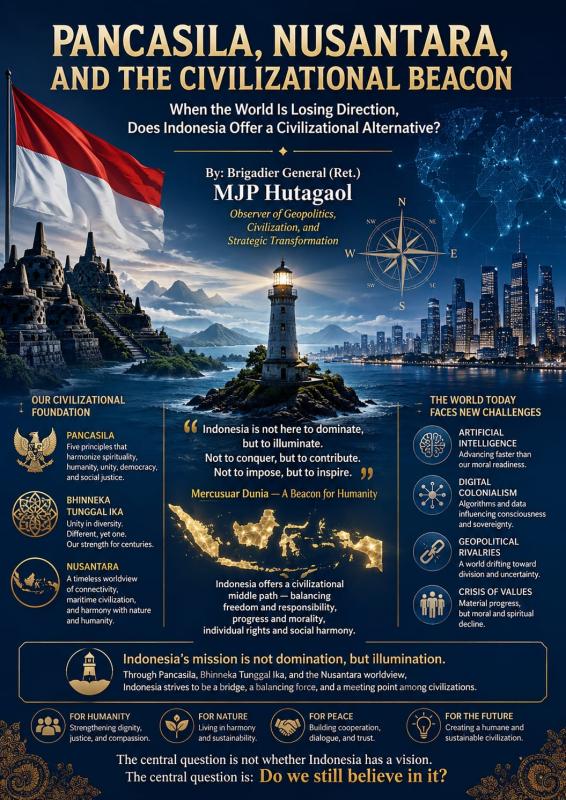
When the World Is Losing Direction, Does Indonesia Offer a Civilizational Alternative?
Jakarta, May 31, 2026
By: Brigadier General (Ret.) MJP Hutagaol
INTRODUCTION: A WORLD ENTERING AN AGE OF TURBULENCE
The world today is moving into an increasingly uncertain era.
Wars continue across multiple regions.
Geopolitical competition among the United States, China, Russia, and other major powers is becoming more intense.
Artificial Intelligence is advancing at a pace that often exceeds humanity's moral and institutional readiness.
Global capital is increasingly concentrated in the hands of a small number of powerful actors.
Meanwhile, digital platforms and algorithms are gradually shaping how people think, choose, communicate, and even understand themselves.
Humanity has become more connected than ever before through technology, yet many societies are simultaneously experiencing crises of identity, meaning, morality, and social cohesion.
The world may be advancing technologically, but not necessarily advancing civilizationally.
Against this backdrop, an important question emerges:
Will Indonesia merely become a large market within the global system?
Or does Indonesia possess a distinctive civilizational vision that it can offer to the world?
This question invites us to revisit Pancasila, not merely as Indonesia's state ideology, but as a philosophical framework with continuing relevance in an age of global uncertainty.
NUSANTARA AND ITS HISTORICAL CONNECTION TO THE WORLD
Long before the emergence of Srivijaya and Majapahit, the Nusantara region had already been connected to global networks of trade and civilization.
Barus, located on the western coast of Sumatra, was known for centuries as one of the world's important centers of aromatic trade.
Camphor, incense, resins, and other tropical commodities linked the archipelago to India, Persia, Arabia, and China through the maritime routes of the Indian Ocean.
Archaeological discoveries and historical records from Greek, Arab, Indian, and Chinese sources indicate that Nusantara was never an isolated region.
Rather, it was an active participant in the exchange of goods, ideas, cultures, and knowledge.
From this maritime foundation emerged great civilizations such as Srivijaya, which became a center of Buddhist learning and maritime commerce, and Majapahit, which developed the concept of Nusantara as a geopolitical and civilizational network connecting diverse islands, peoples, and cultures.
Modern Indonesia therefore did not emerge from a historical vacuum.
It represents the continuation of a long civilizational journey shaped by centuries of interaction with the wider world.
INDONESIA, PANCASILA, AND NUSANTARA: THREE DISTINCT DIMENSIONS
Indonesia, Pancasila, and Nusantara are often treated as interchangeable concepts.
In reality, they represent three different dimensions of the Indonesian experience.
Indonesia is the modern nation-state proclaimed in 1945.
Pancasila serves as the philosophical foundation and state ideology of the Republic of Indonesia. Its five principles—Belief in One Supreme God, Humanity, National Unity, Democracy through Deliberation, and Social Justice—provide the moral and constitutional framework for national life.
Bhinneka Tunggal Ika, commonly translated as "Unity in Diversity," functions as Indonesia's national motto and symbolizes the commitment to maintaining unity amid diversity.
Meanwhile, Nusantara represents a broader geopolitical and civilizational worldview through which Indonesians understand their relationship with the archipelago, the region, and the wider world.
The founders of Indonesia were not merely building an independent state.
They were attempting to establish a civilizational direction.
This helps explain why Sukarno consistently spoke not only about political independence, but also about national dignity, self-reliance, cultural confidence, and Indonesia's future role as a civilizational beacon.
BHINNEKA TUNGGAL IKA: UNITY WITHOUT UNIFORMITY
At a time when many societies are increasingly divided by race, religion, ideology, and identity politics, Indonesia possesses a philosophical heritage that remains remarkably relevant.
The phrase Bhinneka Tunggal Ika originated from the fourteenth-century Kakawin Sutasoma written by Mpu Tantular during the Majapahit era. Its meaning is simple yet profound: Unity in Diversity.
However, Bhinneka Tunggal Ika is more than a national motto. It is a civilizational principle. It recognizes that differences do not have to lead to conflict and that diversity does not have to destroy unity.
Long before many modern nation-states emerged, the Nusantara civilization had already developed an understanding that multiple ethnicities, cultures, and beliefs could coexist within a shared political and cultural framework.
In today's increasingly polarized world, this principle may be more relevant than ever. Indonesia's greatest strength may not lie solely in its population, natural resources, or strategic geography. Its greatest strength may lie in its historical experience of maintaining unity amid diversity.
PANCASILA: A CIVILIZATIONAL MIDDLE PATH
Why did Indonesia's founding fathers reject ideological extremes?
Why did they not fully embrace liberal individualism, communism, unrestricted capitalism, or a theocratic state?
The answer lies in their understanding of Indonesia itself. Indonesia was too vast, too diverse, and too complex to be sustained by a single exclusive ideology.
Extreme individualism risked weakening social solidarity. Communism risked suppressing human freedom and spiritual life. Religious exclusivism risked dividing a pluralistic society.
As a result, Indonesia's founders sought a different path.
Pancasila emerged as a civilizational middle path.
Within its five principles are found the values of spirituality, humanity, national unity, deliberative democracy, and social justice.
Rather than choosing one dimension at the expense of another, Pancasila seeks balance between individual rights and collective responsibility, freedom and social harmony, modern progress and moral values, as well as national identity and universal humanity.
For this reason, Pancasila should not be viewed merely as a political doctrine. It represents an effort to create equilibrium within civilization itself.
Perhaps this explains why Pancasila continues to retain relevance in an era characterized by ideological polarization and global uncertainty.
INDONESIA IS NOT ANTI-WESTERN NOR ANTI-MODERN
The Indonesian civilizational vision does not reject modernity, nor does it seek isolation from the wider world.
Indonesia must continue to advance in science, technology, innovation, Artificial Intelligence, education, and economic development.
The challenge is not whether Indonesia should modernize. The challenge is how modernization can proceed without losing cultural identity and civilizational direction.
Technological progress without moral foundations can generate prosperity without wisdom. Economic growth without social justice can produce wealth without cohesion. Political freedom without responsibility can create instability rather than democracy.
Therefore, Indonesia's task is not to choose between tradition and modernity. Its task is to build a modern civilization rooted in the values of Pancasila, the spirit of Bhinneka Tunggal Ika, and the worldview of Nusantara
MERCUSUAR DUNIA: INDONESIA AS A CIVILIZATIONAL BEACON
The phrase Mercusuar Dunia, often translated as "Beacon of the World," is frequently misunderstood as merely political rhetoric.
In reality, its meaning is much deeper.
A beacon does not dominate the ocean.
A beacon provides direction.
It guides travelers through darkness, uncertainty, and storms.
When Sukarno envisioned Indonesia as a Mercusuar Dunia, he was not primarily speaking about power. He was speaking about purpose.
Indonesia was not meant to become merely another post-colonial state struggling for survival. It was envisioned as a nation capable of contributing ideas, values, and moral leadership to humanity.
In this sense, Indonesia's civilizational mission is not domination but illumination.
Not conquest, but contribution.
Not hegemony, but guidance.
The concepts of Pancasila, Bhinneka Tunggal Ika, and Nusantara converge in this vision.
Together, they form the philosophical foundation of Indonesia's potential role as a bridge, a balancing force, and a meeting point among civilizations.
DIGITAL COLONIALISM AND THE FUTURE OF HUMANITY
The forms of domination confronting humanity today differ significantly from those of previous centuries.
Traditional colonialism relied upon military force and territorial control.
Contemporary forms of domination increasingly operate through algorithms, digital platforms, data monopolies, technological dependence, and information ecosystems.
If colonialism once controlled territory, digital colonialism increasingly seeks to influence consciousness itself.
People are subtly guided regarding what they see, what they believe, what they value, and even how they perceive themselves.
Artificial Intelligence may become the most transformative technological development in human history.
Yet a critical question remains:
Will humanity remain the master of technology, or gradually become subject to the systems it has created?
For Indonesia, sovereignty in the twenty-first century cannot be limited to territorial defense alone.
It must also include intellectual sovereignty, cultural sovereignty, technological sovereignty, and civilizational sovereignty.
Without these foundations, political independence may become increasingly fragile in the digital age.
INDONESIA'S GREAT CHALLENGE
The greatest challenge facing Indonesia today is not preserving Pancasila as a symbol.
The real challenge is translating its values into reality.
Does the legal system genuinely deliver justice?
Does economic development benefit society as a whole or merely deepen inequality?
Does education strengthen character as well as knowledge?
Does technology serve humanity, or does humanity increasingly serve technology?
Does democracy continue to be guided by wisdom and deliberation, or is it gradually dominated by money, image-making, and algorithmic influence?
A nation may achieve economic growth while slowly losing its civilizational direction.
History repeatedly shows that material progress alone is not enough to sustain a civilization.
CONCLUSION: DOES INDONESIA STILL BELIEVE IN ITSELF?
The world today is not merely competing over resources, technology, markets, and military power.
It is also competing over narratives, identities, values, and visions of the future.
Indonesia possesses extraordinary philosophical assets: Pancasila, Bhinneka Tunggal Ika, and the Nusantara worldview.
The central question is not whether Indonesia possesses a civilizational foundation.
The central question is whether Indonesians themselves still believe in it.
Nations that lose confidence in their own identity eventually lose direction in history.
Nations that remain rooted in their values while adapting to change possess the capacity to endure and contribute.
Perhaps the greatest challenge facing Indonesia in the twenty-first century is not merely becoming a prosperous nation.
Perhaps its greatest challenge is remaining authentically Indonesian while helping humanity navigate an age of profound transformation.
If Indonesia succeeds in that mission, the vision of becoming a Civilizational Beacon may no longer remain a historical aspiration.
It may become a meaningful contribution to a world searching for balance between technological advancement and human values.
Jakarta, May 31, 2026
Brigadier General (Ret.) MJP Hutagaol
Observer of Geopolitics, Civilization, and Strategic Transformation