From Jamu and Traditional Healing to Barus, Camphor, and the Ancient Global Trade Routes
Jakarta, May 28, 2026
Baca juga : THINKING-KETIKA DATA BELUM MENJADI PENGETAHUAN
By: Brigadier General(Ret) MJP Hutagaol ‘86’
INTRODUCTIONSOMETHING IS MISSING FROM THE CIVILIZATIONAL MEMORY OF INDONESIA
Baca juga : SENSING-NEGARA HARUS MAMPU MENGINDERA PERUBAHAN
Today, the world recognizes several major systems of medicine.
China has:
Baca juga : KETIKA MEDAN PERTAHANAN BERUBAH
acupuncture,
traditional healers,
and Traditional Chinese Medicine.
India has Ayurveda.
The West has modern medicine based on laboratories, pharmaceutical industries, and medical technology.
But a major question emerges:
Where does Nusantara stand?
Nusantara — the Indonesian archipelago — is:
one of the world’s largest biodiversity regions,
historically one of the greatest spice trade centers,
a vast maritime civilization,
and a tropical region inhabited for centuries by kingdoms, sailors, warriors, farmers, and indigenous communities deeply connected to nature.
Logically, it is difficult to imagine that such a vast civilization never developed sophisticated healing knowledge.
Great kingdoms such as:
Srivijaya,
Majapahit,
Aceh,
Bugis-Makassar,
Mataram,
Ternate,
Tidore,
and countless indigenous societies across Sumatra, Java, Kalimantan, Sulawesi, Bali, Maluku, and Papua,
must have faced:
war injuries,
epidemics,
tropical diseases,
childbirth complications,
poisons,
fractures,
exhaustion from long sea voyages,
and the physical recovery of warriors and sailors.
This means one thing:
Healing knowledge must have existed.
And because Nusantara consists of thousands of islands with different climates and ecosystems, it is highly likely that every region developed:
medicinal plants,
healing methods,
herbal formulas,
and local medical traditions of its own.
In other words:
Nusantara’s healing traditions were never the property of one ethnic group or one island alone.
They formed a vast mosaic of knowledge stretching from Sumatra to Papua.
Yet today, the world rarely hears the phrase:“The Medical Civilization of Nusantara.”
THE MISSING LINK OF NUSANTARA CIVILIZATION
This is where a major historical missing link may exist.
Perhaps Nusantara possessed rich healing knowledge, but:
it was never consolidated,
never nationally documented,
mostly passed down orally,
scattered across kingdoms and tribes,
intertwined with spirituality and local traditions,
and gradually fragmented through colonialism and modernization.
Unlike China, which:
preserved manuscripts,
institutionalized knowledge,
built schools,
protected traditional medicine,
and integrated it into the modern nation-state,
Nusantara experienced:
centuries of colonial domination,
the loss of manuscripts,
the collapse of traditional centers of learning,
and a modern mindset that often dismissed local knowledge as primitive or unscientific.
Yet traces of this knowledge still survive today.
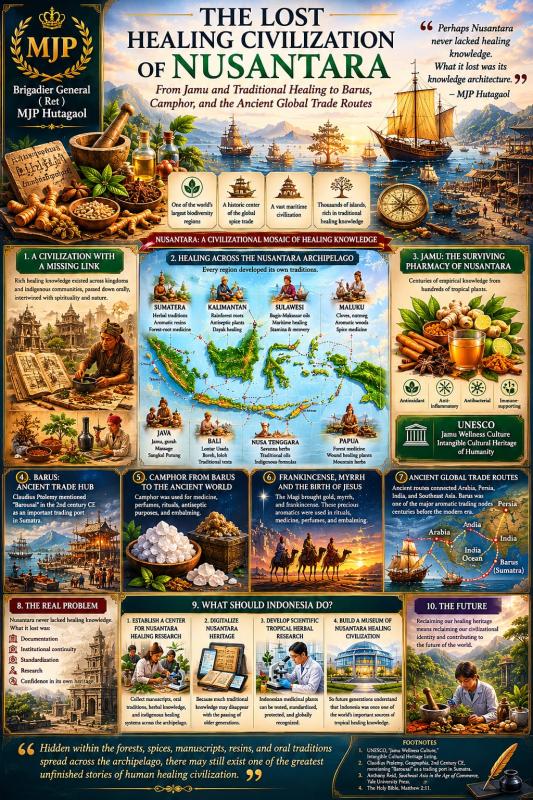
HEALING ACROSS THE NUSANTARA ARCHIPELAGO
Almost every region in Nusantara developed its own healing traditions.
In Java:
jamu herbal medicine,
traditional massage,
gurah,
and Sangkal Putung bone healing.
In Sumatra:
Batak pustaha manuscripts,
Malay herbal traditions,
aromatic resins,
forest-root medicine,
and traditional healing systems from Aceh and Minangkabau.
In Kalimantan, Dayak communities preserved:
rainforest medicinal roots,
poison antidotes,
antiseptic plants,
and tropical forest healing systems.
In Sulawesi:
Bugis-Makassar oils,
maritime healing methods,
stamina remedies,
and recovery techniques for sailors.
In Bali:
Lontar Usada manuscripts,
boreh,
loloh,
and one of the most preserved traditional healing documentation systems in Indonesia.
In Nusa Tenggara:
savanna-based medicinal plants,
traditional oils,
and indigenous healing formulas developed under dry tropical conditions.
In Maluku:
cloves,
nutmeg,
aromatic woods,
and spice-based medicinal traditions became part of daily life.
Meanwhile in Papua,indigenous communities have long used:
forest medicine,
wound-healing plants,
mountain herbs,
and survival-based healing knowledge that remains largely understudied by modern science.
Taken together, Nusantara itself was essentially:a massive living tropical laboratory.
But all of this knowledge evolved separately.
It was never organized into a unified “medical architecture of Nusantara.”
JAMU:THE SURVIVING PHARMACY OF NUSANTARA
No discussion about Nusantara healing traditions can ignore jamu.
Because jamu is not merely a traditional drink.
It represents:
empirical knowledge,
centuries of observation of nature,
and a natural pharmaceutical tradition developed by local communities.
Jamu combines ingredients such as:
turmeric,
ginger,
temulawak,
galangal,
lemongrass,
cinnamon,
betel leaf,
tamarind,
cloves,
nutmeg,
and hundreds of tropical plants native to the archipelago.
Interestingly, many jamu ingredients are now being studied scientifically for their:
antioxidant,
anti-inflammatory,
antibacterial,
and immune-supporting properties.
In other words:
What was once dismissed as “village medicine” is increasingly being validated by modern research.
UNESCO has even recognized Jamu Wellness Culture as an Intangible Cultural Heritage of Humanity.¹
THE TROPICAL BOTANICAL TREASURE OF NUSANTARA
Indonesia remains one of the richest biological regions on Earth.
Its forests contain:
thousands of medicinal plants,
roots,
resins,
spices,
leaves,
and natural compounds that are still insufficiently researched.
For centuries, local communities used plants to treat:
fever,
wounds,
infections,
digestive disorders,
poisoning,
childbirth recovery,
and physical exhaustion.
Examples include:
betel leaf as a natural antiseptic,
turmeric for inflammation,
ginger for body warmth,
temulawak for digestion,
sambiloto for immunity,
eucalyptus oil for respiration,
and countless rainforest herbs from Kalimantan and Papua that remain scientifically unexplored.
The question is:
If all of this exists,why has Indonesia not become a global center for tropical herbal research?
BARUS:THE ANCIENT GATEWAY CONNECTING NUSANTARA TO THE WORLD
When the name Barus appears in history,the perspective begins to change.
Located on the western coast of Sumatra, Barus was historically famous for:
camphor,
and benzoin incense.
Even the term “kapur barus” derives from the name Barus itself.
Remarkably, the Greek geographer Claudius Ptolemy mentioned “Barousai” in the 2nd century CE as an important trading port.²
This means:
Long before European colonialism,long before the VOC,Barus was already connected to international trade networks.
CAMPHOR, MUMMIES, AND THE ANCIENT AROMATIC TRADE
Historical records indicate that camphor from Sumatra was highly valued in ancient trade.
Camphor was used for:
medicine,
perfumes,
rituals,
antiseptic purposes,
and embalming traditions.
Some historical discussions even connect the ancient camphor trade to preservation practices associated with Egypt and the Middle East.
While historians and scientists continue debating the exact origins of embalming materials used in ancient Egypt, the trade connection between:
Sumatra,
Arabia,
Persia,
India,
and the wider ancient world,
is historically well established.³
At one point, camphor from Barus was considered as valuable as gold.
FRANKINCENSE, MYRRH, AND THE BIRTH OF JESUS
In the Christian tradition,the Magi who visited the newborn Jesus brought gifts of:
gold,
myrrh,
and frankincense.⁴
These were not ordinary materials.
Myrrh and frankincense were used in:
rituals,
medicine,
perfumery,
and embalming.
This raises an intriguing historical question:
Where did the ancient world obtain its highly prized aromatic substances?
Ancient trade routes connected:
Arabia,
Persia,
India,
and Southeast Asia.
And Barus was one of the major aromatic trading nodes within these ancient networks.
This does not mean all incense came from Nusantara.
But it strongly suggests that Nusantara was already integrated into global trade and healing networks centuries before the modern era.
THE REAL PROBLEM:NUSANTARA LOST ITS KNOWLEDGE ARCHITECTURE
Perhaps Nusantara never lacked healing knowledge.
What it lost was:
documentation,
institutional continuity,
standardization,
research,
and the confidence to preserve its own intellectual heritage.
For too long, Indonesia was positioned merely as:
a supplier of raw materials,
a spice-producing colony,
a market,
rather than a center of knowledge.
As a result,modern generations often know imported products better than the medicinal plants growing in their own soil.
WHAT SHOULD INDONESIA DO?
If taken seriously,Indonesia could begin rebuilding this forgotten civilizational memory.
ESTABLISH A CENTER FOR NUSANTARA HEALING RESEARCH
A national effort to collect:
manuscripts,
oral traditions,
herbal knowledge,
and indigenous healing systems across the archipelago.
DIGITALIZE NUSANTARA HERITAGE
Because much traditional knowledge may disappear with the passing of older generations.
DEVELOP SCIENTIFIC TROPICAL HERBAL RESEARCH
So Indonesian medicinal plants can be:
scientifically tested,
standardized,
protected,
and globally recognized.
BUILD A MUSEUM OF NUSANTARA HEALING CIVILIZATION
So future generations understand that Indonesia was not merely a consumer of modern medicine,but may once have been one of the world’s important sources of tropical healing knowledge.
CONCLUSIONPERHAPS NUSANTARA DID NOT LOSE ITS HEALING KNOWLEDGE —ONLY ITS MEMORY OF IT
Barus, jamu, Sangkal Putung, Batak pustaha manuscripts, Balinese Usada texts, Dayak forest medicine, Bugis maritime remedies, and Papuan botanical traditions all point toward one profound possibility:
That Nusantara may once have possessed:
a vast tropical healing tradition,
herbal medical systems,
therapeutic knowledge,
and connections to ancient global health and aromatic trade networks.
But history fragmented this memory.
And perhaps the greatest missing link of Indonesia is not the loss of medicinal plants themselves.
But the loss of confidence in its own civilizational knowledge.
Because hidden within the forests, spices, manuscripts, resins, and oral traditions spread across the archipelago,there may still exist one of the greatest unfinished stories of human healing civilization.
Jakarta. ,28 May 2026
Brigadier General ( Ret ) MJP.Hutagaol
FOOTNOTES
UNESCO, “Jamu Wellness Culture,” Intangible Cultural Heritage listing.
Claudius Ptolemy, Geographia, 2nd Century CE, mentioning “Barousai” as a trading port in Sumatra.
Anthony Reid, Southeast Asia in the Age of Commerce, Yale University Press.
The Holy Bible, Matthew 2 : 11
TAGS : Brigjen Purn MJP Hutagaol