
FROM PARIS TO MERAUKE
FROM PARIS TO MERAUKE
Reporter: luska
Redaktur: Rikard Djegadut
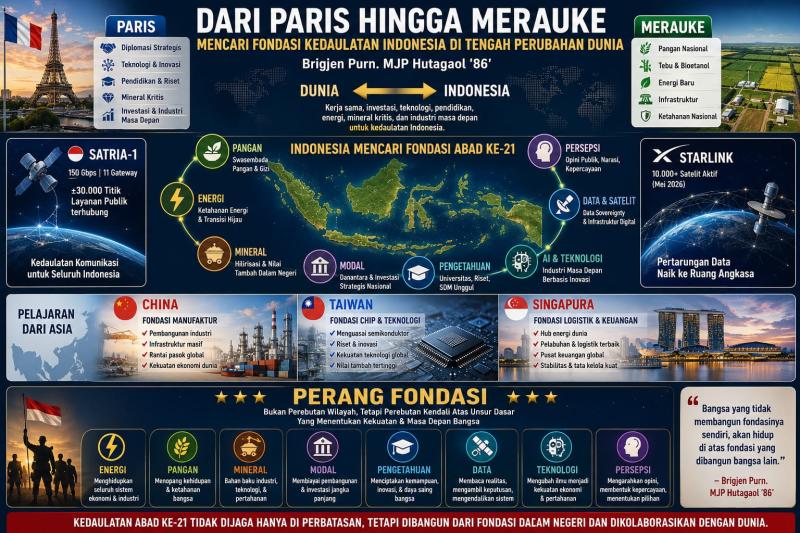
Indonesia's Search for Strategic Foundations in a Changing World
By Brigadier General (Ret.) MJP Hutagaol '86'
Jakarta, 1June 2026
ABSTRACT
The 21st century is reshaping the foundations of national power. Military strength remains important, but it is no longer sufficient to explain why some nations rise while others stagnate. Food security, energy resilience, critical minerals, capital formation, technological capability, data infrastructure, and public perception increasingly determine a nation's ability to survive and compete.
Against this backdrop, Indonesia's recent diplomatic engagements and domestic development initiatives reveal a broader strategic pattern. From Paris to Merauke, from critical minerals to artificial intelligence, from village cooperatives to satellite communications, Indonesia appears to be searching for the foundations of its future sovereignty.
This essay argues that these seemingly disconnected developments can be understood through a broader framework: the competition for strategic foundations that underpin national resilience in the 21st century.
INTRODUCTION
A simple question deserves serious attention:
What connects Paris, Merauke, food security, nickel, tin, Danantara, artificial intelligence, universities, satellites, and village cooperatives?
At first glance, these issues appear unrelated.
Paris represents diplomacy.
Merauke represents agriculture.
Nickel and tin represent mining.
Danantara represents capital.
Artificial intelligence represents technology.
Universities represent knowledge.
Satellites represent communications.
Village cooperatives represent grassroots economics.
Yet viewed through a wider strategic lens, they point toward a single question:
What foundations is Indonesia building to navigate a rapidly changing world?
This question matters because the international system is entering a period of profound transformation.
The post-Cold War order is increasingly challenged by geopolitical rivalry, technological competition, supply chain fragmentation, energy insecurity, and the accelerating impact of artificial intelligence.
The assumptions that shaped the last three decades are beginning to erode.
As a result, nations are once again asking fundamental questions about sovereignty, resilience, and strategic autonomy.
For Indonesia, these questions are particularly important.
With a population exceeding 280 million, vast natural resources, a strategic location between the Indian and Pacific Oceans, and growing geopolitical relevance, Indonesia possesses significant potential.
The challenge is not whether Indonesia has resources.
The challenge is whether Indonesia can transform those resources into lasting national strength.
A WORLD IN TRANSITION
Throughout much of the twentieth century, national power was measured through visible indicators:
Military capability.
Industrial production.
Territorial control.
Natural resources.
Economic size.
These factors remain important.
However, the twenty-first century has introduced new dimensions of competition.
The Russia–Ukraine conflict demonstrates that energy remains a strategic weapon.
The competition between the United States and China highlights the importance of manufacturing, semiconductors, supply chains, and advanced technology.
Artificial Intelligence has emerged as a new arena of strategic competition, influencing economic productivity, military capability, information systems, and governance itself.
Meanwhile, social media and digital platforms have transformed perception into a strategic domain.
Public opinion can shift within hours.
A single narrative can influence elections, markets, and international relations.
A single disruption in data infrastructure can undermine public trust.
In this environment, national resilience depends upon far more than military strength alone.
It depends upon the foundations that support economic activity, technological development, social cohesion, and strategic decision-making.
The nations that understand this transformation will shape the future.
Those that do not may find themselves increasingly dependent on foundations built by others.
LESSONS FROM CHINA, TAIWAN, AND SINGAPORE
The rise of China offers one of the most important lessons of modern statecraft.
China did not become a manufacturing superpower overnight.
Its transformation was built over decades through sustained investment in infrastructure, industrial capacity, technical education, research, logistics, and energy systems.
What appears today as economic power is, in reality, the result of long-term foundation building.
Taiwan offers a different but equally important lesson.
Despite limited territory and natural resources, Taiwan became one of the world's most critical semiconductor centers.
Through technological specialization and sustained investment in innovation, Taiwan established itself as an indispensable node in the global digital economy.
Singapore presents yet another model.
Without major natural resources, it built strategic advantages in logistics, finance, maritime trade, and energy services.
Its influence derives not from the abundance of resources, but from its ability to position itself at critical intersections of global commerce.
These three examples differ in scale and circumstance.
Yet they share a common principle:
Nations become influential not simply because they possess resources, but because they build strategic foundations over time.
This lesson is highly relevant for Indonesia today.
FROM BEIJING TO PARIS
Indonesia's recent diplomacy should be viewed within this broader strategic context.
President Prabowo Subianto's engagements across Asia, the Middle East, Europe, and global forums suggest an effort to expand Indonesia's strategic options in an increasingly fragmented world.
The state visit to France in May 2026 illustrates this approach.
While defense cooperation received significant attention, discussions between Indonesia and France extended well beyond military affairs.
They included higher education, research collaboration, technological innovation, critical minerals, sustainable mining, energy cooperation, agriculture, and future industries.
These themes are noteworthy because they mirror many of Indonesia's domestic priorities.
Abroad, Indonesia discusses technology, investment, energy, education, and industrial transformation.
At home, Indonesia is pursuing food security initiatives, downstream industrialization, research partnerships, digital infrastructure, and human capital development.
The parallel is difficult to ignore.
It suggests that Indonesia may be attempting to align its external diplomacy with its internal development agenda.
Whether this effort succeeds remains to be seen.
But the pattern itself is significant
FOOD SECURITY AS THE FIRST FOUNDATION
No nation can claim true sovereignty if it cannot secure its own food supply.
Military power, diplomatic influence, and economic growth ultimately depend upon a stable and healthy population.
Food insecurity has historically contributed to political instability, social unrest, and economic vulnerability across many parts of the world.
For this reason, food should not be viewed merely as an agricultural issue.
It is a strategic issue.
It is a national security issue.
It is a development issue.
Indonesia's efforts to strengthen food security through programs such as the Free Nutritious Meals initiative, agricultural modernization, and food estate development reflect an increasing recognition of this reality.
The significance of these programs extends beyond immediate economic benefits.
Food security influences:
Human capital development.
Public health.
Educational outcomes.
Labor productivity.
Social stability.
A healthy generation becomes a productive generation.
A productive generation strengthens national competitiveness.
In this sense, investments in food security are also investments in future sovereignty.
MERAUKE: MORE THAN A FOOD ESTATE
Among Indonesia's various development initiatives, Merauke deserves particular attention.
Many observers describe Merauke primarily as a large-scale agricultural project.
Such descriptions underestimate its strategic significance.
Merauke represents the intersection of several national priorities:
Food security.
Energy security.
Infrastructure development.
Territorial integration.
Regional development.
National resilience.
Plans involving large-scale agricultural expansion, sugar production, and bioethanol development indicate ambitions that extend beyond food production alone.
The development of transportation networks, logistics infrastructure, and supporting industries further reinforces this broader strategic vision.
Viewed from this perspective, Merauke is not merely about cultivating land.
It is about building strategic capacity.
It is about strengthening Indonesia's presence in its eastern territories.
It is about transforming underutilized resources into productive assets.
At the same time, large-scale projects of this nature inevitably generate legitimate questions regarding environmental sustainability, indigenous communities, land governance, and long-term economic viability.
These concerns should not be dismissed.
Successful strategic development requires balancing national objectives with social responsibility and environmental stewardship.
If managed effectively, Merauke could become a symbol of Indonesia's food and energy resilience.
If mismanaged, it could become a costly lesson.
The difference will depend on governance.
VILLAGE COOPERATIVES AND THE LOCAL ECONOMY
National strength ultimately rests upon local strength.
Indonesia is not defined solely by Jakarta, Surabaya, Bandung, or Medan.
Indonesia lives in its villages.
Its food production originates there.
Its cultural identity is rooted there.
Its social resilience often depends upon local communities.
This is why village cooperatives deserve strategic attention.
The Village Cooperative Program should not be viewed merely as a rural economic initiative.
At its best, it can function as a mechanism for:
Market access.
Distribution efficiency.
Financial inclusion.
Agricultural support.
Local economic empowerment.
A farmer who lacks access to markets remains vulnerable.
A fisherman without access to logistics remains vulnerable.
A small entrepreneur without access to capital remains vulnerable.
Strong local institutions can reduce these vulnerabilities.
However, cooperatives succeed only when supported by transparency, professional management, accountability, and community participation.
The lesson is simple:
Economic sovereignty cannot be built exclusively from the top down.
It must also be built from the bottom up.
CRITICAL MINERALS AND THE QUESTION OF VALUE CREATION
Indonesia possesses one of the world's richest endowments of natural resources.
Yet history demonstrates that natural wealth alone does not guarantee national prosperity.
Many resource-rich countries have remained economically fragile despite abundant reserves.
The critical question is therefore not:
"What resources do we possess?"
The more important question is:
"Who captures the value created by those resources?"
This issue is particularly relevant in relation to nickel, tin, copper, and other strategic minerals.
Global demand for these resources continues to increase due to:
Electric vehicles.
Renewable energy systems.
Battery manufacturing.
Data centers.
Artificial intelligence infrastructure.
Indonesia has emerged as one of the world's most important nickel producers.
Papua remains strategically significant due to its copper and gold reserves.
Tin continues to play a vital role in modern industrial supply chains.
The challenge facing Indonesia is not simply extraction.
The challenge is value creation.
Downstream industrialization, technology transfer, workforce development, and domestic industrial capability will determine whether resource wealth becomes long-term national strength.
Without these elements, a nation may export resources while importing prosperity.
DANANTARA AND THE FOUNDATION OF CAPITAL
Every major development strategy requires capital.
Food security requires investment.
Infrastructure requires investment.
Technology requires investment.
Research requires investment.
Industrial transformation requires investment.
Danantara enters this discussion as an attempt to strengthen Indonesia's long-term investment capacity.
Its potential significance lies not merely in the scale of assets under management.
Its significance lies in the possibility of aligning national capital with long-term strategic objectives.
The concept is straightforward.
Rather than viewing state assets solely as sources of short-term revenue, they can be leveraged to support future-oriented investments in:
Industrial development.
Technology.
Energy.
Infrastructure.
Food security.
However, large investment institutions are never judged by ambition alone.
They are judged by governance.
The international experience is clear.
Successful sovereign wealth funds rely upon:
Transparency.
Accountability.
Professional management.
Political discipline.
Long-term strategic vision.
Without these elements, large pools of capital can become sources of inefficiency and rent-seeking.
With them, they can become engines of national transformation.
THE KNOWLEDGE FOUNDATION: UNIVERSITIES, RESEARCH, AND AI
Natural resources can generate wealth.
Knowledge creates enduring power.
Throughout history, nations that successfully transformed themselves invested heavily in education, research, innovation, and technological capability.
The same principle applies today.
Artificial Intelligence represents one of the most significant technological shifts of the modern era.
Its influence extends across:
Industry.
Defense.
Healthcare.
Education.
Governance.
Scientific research.
Countries that merely consume AI technologies will remain dependent.
Countries that contribute to their development will shape the future.
This reality elevates the importance of universities, research institutions, innovation ecosystems, and human capital development.
Education should therefore be viewed not only as a social policy.
It should also be viewed as a strategic investment.
Research is not merely academic activity.
It is an instrument of national capability.
Knowledge has become one of the most important foundations of modern sovereignty.
FROM FARMLANDS TO SATELLITES
The strategic competition of the twenty-first century is no longer confined to land and sea.
It increasingly extends into cyberspace, data networks, and even outer space.
For decades, satellites were viewed primarily as communication tools.
Today, they have become critical infrastructure.
Satellites support:
Communications.
Navigation.
Banking systems.
Transportation.
Disaster management.
Defense operations.
Digital economies.
Artificial intelligence ecosystems.
In many ways, satellites have become the invisible infrastructure of modern civilization.
A nation may not notice them in daily life.
Yet millions of activities depend upon them every second.
This transformation has elevated space from a scientific frontier into a strategic domain.
The competition is no longer about who reaches space first.
The competition is about who controls the infrastructure that supports life on Earth.
STARLINK, SPACEX, AND A NEW MODEL OF POWER
One of the most striking examples of this transformation is Starlink.
With more than ten thousand operational satellites in orbit, Starlink has become one of the largest satellite constellations ever deployed.
Its significance extends far beyond internet connectivity.
Starlink demonstrates how control over communications infrastructure can create strategic influence across continents.
What makes this development particularly remarkable is that it is driven not by a nation-state alone, but by a private corporation.
This reflects a broader shift in global power dynamics.
Historically, governments dominated strategic infrastructure.
Today, major technology companies increasingly operate systems whose influence extends across national boundaries.
Elon Musk's ecosystem illustrates this trend.
Tesla participates in energy transformation.
SpaceX participates in space infrastructure.
Starlink participates in communications and data networks.
Artificial intelligence initiatives participate in the emerging knowledge economy.
Taken together, these activities reveal a broader lesson.
Modern power increasingly emerges from interconnected foundations rather than isolated industries.
The future belongs not merely to those who build products.
It belongs to those who build ecosystems.
SATRIA-1 AND INDONESIA'S DIGITAL FOUNDATION
Indonesia is not absent from this transformation.
The SATRIA-1 satellite represents an important effort to strengthen national digital infrastructure.
Designed to connect remote regions across the archipelago, SATRIA-1 provides connectivity for schools, healthcare facilities, government offices, and public services.
Its significance extends beyond technology.
For an archipelagic nation, connectivity is a matter of national cohesion.
Distance remains one of Indonesia's greatest structural challenges.
Thousands of islands, varying levels of infrastructure, and geographic fragmentation create obstacles to equal access.
Digital infrastructure helps bridge these gaps.
In this context, SATRIA-1 should be viewed not merely as a telecommunications project.
It is part of a broader effort to strengthen Indonesia's strategic foundation.
The key question for the future is whether Indonesia will remain primarily a consumer of global digital infrastructure or gradually develop greater technological and strategic autonomy.
This question will become increasingly important as artificial intelligence, cloud computing, and data-driven industries continue to expand.
DATA AS A STRATEGIC RESOURCE
During the industrial era, oil became the defining strategic resource.
In the digital era, data increasingly occupies a similar position.
Every economic transaction generates data.
Every communication generates data.
Every digital interaction generates data.
Data enables prediction.
Data enables optimization.
Data enables influence.
Data enables decision-making.
The organizations and nations capable of collecting, processing, and utilizing data effectively gain significant advantages.
This reality explains the growing importance of:
Data centers.
Cloud infrastructure.
Artificial intelligence.
Digital platforms.
Cybersecurity.
Data has become more than information.
It has become a strategic asset.
Yet data alone is not enough.
Raw data has limited value.
Its significance emerges when it is transformed into knowledge.
Knowledge, in turn, influences decisions.
And decisions ultimately shape power.
THE INVISIBLE BATTLEFIELD: PERCEPTION
Beyond food, energy, minerals, capital, knowledge, and data lies another strategic foundation.
Perception.
Perception is where information becomes meaning.
Perception shapes trust.
Perception influences legitimacy.
Perception affects behavior.
In the digital age, perception can spread faster than any military force.
A narrative can travel globally within minutes.
A rumor can influence markets.
A viral video can reshape public opinion.
A coordinated information campaign can alter political outcomes.
This reality does not mean that facts no longer matter.
It means that facts alone are often insufficient.
Public understanding becomes a strategic factor.
Governments, institutions, and organizations must therefore compete not only in performance but also in communication.
Successful policies that are poorly understood may fail politically.
Weak policies that are effectively marketed may appear successful.
The competition for perception has become one of the defining characteristics of the twenty-first century.
FOUNDATION WAR
The developments discussed throughout this essay point toward a broader strategic reality.
The central competition of the twenty-first century is increasingly a competition for foundations.
I refer to this phenomenon as:
Foundation War
Foundation War is not defined primarily by territorial conquest.
Nor is it limited to military confrontation.
Rather, it involves competition for control over the foundations that enable nations to function, prosper, and influence their future.
These foundations include:
Food.
Energy.
Critical minerals.
Capital.
Knowledge.
Technology.
Data.
Communications.
Perception.
Food sustains populations.
Energy powers economies.
Minerals support industrial systems.
Capital finances development.
Knowledge drives innovation.
Technology expands capability.
Data improves decision-making.
Communications connect societies.
Perception influences collective behavior.
Together, they form the underlying architecture of national resilience.
A nation may possess political independence while remaining strategically dependent if these foundations are controlled by others.
This is why sovereignty in the twenty-first century is becoming increasingly complex.
Sovereignty is no longer measured solely by borders.
It is also measured by the degree to which a nation controls the foundations of its own future.
CONCLUSION
The rise of China was built upon manufacturing foundations.
Taiwan strengthened its position through semiconductors.
Singapore established itself through logistics and finance.
The United States built powerful foundations in technology, capital, data, and space infrastructure.
The question facing Indonesia is therefore straightforward:
What foundations is Indonesia building today?
From Paris to Merauke.
From food security to artificial intelligence.
From critical minerals to satellite infrastructure.
From village cooperatives to sovereign investment funds.
Indonesia appears to be searching for an answer.
The outcome remains uncertain.
No development strategy is guaranteed to succeed.
No institution is immune from failure.
No policy is beyond criticism.
Yet one principle remains clear.
Nations that fail to build their own foundations eventually become dependent upon foundations built by others.
Nations that successfully build their foundations create the conditions necessary to determine their own future.
The ultimate challenge facing Indonesia is therefore not merely economic growth.
It is the construction of enduring strategic foundations capable of sustaining sovereignty, resilience, and national progress throughout the twenty-first century.
SELECTED REFERENCES
World Economic Forum. Annual Meeting 2026, Davos.
Joint Statement of the Republic of Indonesia and the French Republic, State Visit, Paris, May 2026.
Cabinet Secretariat of the Republic of Indonesia, Presidential Visits and Strategic Cooperation Reports, 2026.
United States Geological Survey (USGS), Mineral Commodity Summaries 2026.
Freeport-McMoRan, Indonesia Operations Overview.
Reuters, Reports on Indonesia's Food Estate, Danantara, and Strategic Investments, 2025–2026.
Ministry of Communication and Digital Affairs of Indonesia, SATRIA-1 Program Documentation.
SpaceX and Space.com, Starlink Constellation Updates, 2026.
World Bank Data, Manufacturing Value Added Statistics.
TrendForce Semiconductor Industry Reports, 2025–2026.
Trade.gov Singapore Country Commercial Guide.
Various official Indonesian government publications concerning MBG, Agrinas, Village Cooperatives, and National Development Programs.
Jakarta ,1 June 2026