*SERIES 3*
Baca juga : MEMBACA INDONESIA MELALUI GERILYA KOGNITIF
*Momentum, Vulnerability, and Asymmetric Logic in Cognitive Guerrilla Warfare*
*By Brigadier General (Ret.) MJP. Hutagaol*
---
*1. A BIG WAVE DOES NOT ALWAYS BEGIN FROM GREAT POWER*
In guerrilla warfare, the weaker side does not face the opponent`s strength in the same way. It avoids unfavorable battles, understands the terrain, reads vulnerabilities, chooses momentum, and maintains endurance.
That principle provides an important lesson for understanding competition in the cognitive space.
An issue initially discussed only by a small group can develop into national attention. Scattered complaints can meet in one demand. An event that initially seemed local can affect the government agenda and test state decisions.
In digital society, such development does not always require one leader or one command center. Individuals, communities, organizations, media, and various networks can move through their respective channels, then be connected by the same issue.
However, is every wave of opinion Cognitive Guerrilla Warfare?
No. This is where we must build precision of thought.
Community movements that grow spontaneously, criticism of the government, and openly organized demonstrations are not automatically cognitive guerrilla operations. All of them can be legitimate democratic dynamics.
This study wants to understand how momentum, vulnerability, dispersed networks, and influence on decisions work in the cognitive space. We must also know the boundary between organic community dynamics and deliberately designed influence operations.
*2. WHY IS IT CALLED COGNITIVE GUERRILLA WARFARE?*
Cognitive Guerrilla Warfare in this series of studies is an analytical framework for understanding the application of guerrilla warfare principles to competition in information, thought, trust, and decision-making.
Physical guerrilla warfare teaches that the weaker side does not have to face dominant power directly. Advantage can be sought through asymmetry, dispersal of forces, selection of momentum, exploitation of vulnerabilities, and ability to endure.
In the cognitive space, those principles take different forms.
Asymmetry means not having to match all communication capabilities and resources of the stronger party.
Dispersion means influence and response can emerge through dispersed networks, not only through one center.
Selection of vulnerability means understanding the part of the information environment, trust, or decision-making process that is currently problematic.
Momentum means understanding when an event gains attention and changes public assessment.
Surprise means facing unexpected changes in circumstances.
Adaptation means adjusting understanding and response to developments in the situation.
Endurance means maintaining the ability to think, coordinate, and make decisions under pressure.
However, those principles must not be applied literally from the physical battlefield to society. In the cognitive space, humans are not merely targets that can be controlled. They have experience, will, rights, and ability to assess information themselves.
Therefore, Cognitive Guerrilla Warfare is not enough to be defined as war to influence minds. Its emphasis is understanding how influence competition takes place asymmetrically and how the ability to think and make decisions is maintained or disrupted.
This framework is a development of thought in our study, not an official NATO doctrine or a universal theory that has finished being debated.
*3. FROM ISSUE TO MOMENTUM: WHAT MAKES IT GROW?*
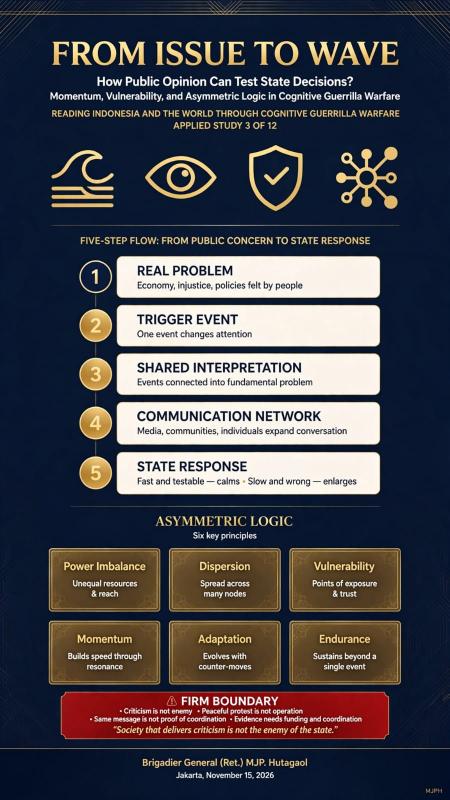
Not all issues develop into a national wave. There are several conditions that can meet each other.
First, real problems.
Society feels economic pressure, injustice, poor services, policies deemed inappropriate, or treatment deemed unfair.
Second, triggering events.
An incident can make previously scattered problems become common attention.
Third, shared interpretation.
Society begins to connect various incidents with a more fundamental problem. They no longer see them as standalone events.
Fourth, communication networks.
Media, communities, organizations, and individuals expand conversation and connect groups that previously did not always communicate.
Fifth, institutional and government responses.
Statements, policies, apparatus actions, or delayed responses can affect the development of the situation. Appropriate responses can ease uncertainty; wrong responses can enlarge the problem.
In communication science, agenda setting is known, the process when a particular issue gains greater attention. There is also framing, the way an event is selected, arranged, and given meaning.
Both concepts help explain why the same event can be understood differently by different community groups.
However, public attention does not automatically produce decision change. Its influence depends on strength of evidence, legitimacy of demands, political conditions, institutional responses, and government ability to solve problems.
*4. LESSONS FROM INDONESIA: AUGUST-SEPTEMBER 2025 DEMONSTRATIONS*
The August-September 2025 demonstrations provide an important example of how a number of problems can meet and develop into national pressure.
One trigger of public attention was the housing allowance for DPR members of Rp50 million per month. That issue became a spotlight amid budget austerity policies and community welfare problems.
However, this problem needs to be explained completely. On August 26, 2025, DPR Deputy Speaker Sufmi Dasco Ahmad stated that payment of Rp50 million per month from October 2024 to October 2025 was an installment of house contract funds for a five-year period, after DPR members no longer received official houses. That clarification did not remove the polemic about its amount and appropriateness, but it is important for readers to understand the facts fully.
Demonstrations took place in Jakarta and a number of regions. Community demands were not only related to DPR member allowances, but also touched on wage issues, inequality, government policies, and accountability of state institutions.
The situation then heated up further after Affan Kurniawan, a 21-year-old online motorcycle taxi driver, died on August 28, 2025 after being hit and run over by a Brimob tactical vehicle. Footage of the incident spread widely through social media and triggered anger and demands for accountability.
That event shows how one incident can change the scale of public attention. Previously diverse issues then met in demands about justice, apparatus accountability, and trust in institutions.
Human Rights Watch report on September 3, 2025 noted that demonstrations had spread to almost 50 cities after video of Affan`s death spread. Meanwhile, Reuters report on September 2, 2025 described expanding unrest also related to inequality, corruption, regional budget cuts, and government spending priorities.
This case shows three things.
First, different problems can meet in one momentum.
Second, dispersed communication networks can accelerate information dissemination and connect community groups.
Third, institutional and government actions also determine whether the situation eases or grows larger.
But we must be careful in drawing conclusions. The demonstrations cannot be declared as Cognitive Guerrilla operations only because mobilization took place through social media and involved dispersed networks. Community anger, demands for justice, and criticism of the government are social and democratic dynamics that must be assessed based on facts.
It is precisely from this case that we learn to distinguish between organically grown opinion waves and deliberately designed influence operations.
*5. WHAT DOES THE RESEARCH REVEAL?*
Two studies on the 2025 demonstrations provide important material for understanding the relationship between media, opinion, and mobilization.
Research by Abdurrahman (2026) in _Online Information Review_ examined how social media played a role in issue framing formation and attention agenda during the August 2025 demonstrations. The study concluded that social media helped connect separate complaints into a more unified demand agenda, and encouraged mainstream media and government institutions to respond.
Meanwhile, research by Eriyanto (2026) compared 2,682 http://Detik.com articles and 421 posts from X account @barengwarga on August 25-September 5, 2025.
The results showed that online media and social media have differences in demonstration framing, source selection, and how to display demonstrator voices.
Social media more often displayed demonstrator voices, debates, and apparatus violence. Online media used more institutional sources and more often linked demonstrations with violence. However, both information spaces equally showed elements of conflict and confrontation.
This finding is important. Social media does not automatically reverse the entire way conventional media reports. It changes part of information presentation patterns and gives greater space to voices previously less visible.
From both studies, we can conclude that digital communication networks can accelerate public agenda formation and expand mobilization. However, the studies do not prove the existence of one hidden command controlling the demonstrations.
*6. WHERE IS THE ASYMMETRIC LOGIC?*
This is the core that distinguishes Cognitive Guerrilla Warfare study from general writing about social media and public opinion.
In guerrilla warfare, the weaker side does not have to control the entire battlefield. It understands conditions, avoids the opponent`s main advantage, and seeks space where its influence can work.
In cognitive competition, asymmetric logic can be read through six dimensions.
1. Power imbalance.
A party with smaller communication resources can gain attention through dispersed networks. However, large attention does not automatically mean deep influence.
2. Dispersion.
Information and response can develop through communities, individuals, and various channels. Dispersed networks do not always have one control center.
3. Vulnerability.
Real problems that have not been resolved, unclear communication, and weakened trust can make the information environment more vulnerable to various narratives.
4. Momentum.
Certain events can change public attention quickly and raise issues that previously were not priorities.
5. Adaptation.
Understanding and response can change following new evidence, event developments, and actions of related institutions.
6. Endurance.
Problems left continuously can affect trust and society`s relationship with state institutions in the long term.
These six dimensions are tools for reading influence dynamics. Not all must be present in every event. Their existence also does not automatically prove organized operations.
*7. DISPERSED NETWORKS: WHEN DO THEY BECOME INFLUENCE OPERATIONS?*
Research by Wijayanto and colleagues in _The International Journal of Press/Politics_ provides a picture of domestic influence operations through social media in Indonesia.
The study involved interviews with 52 people involved in the cyber troop ecosystem: 23 account operators, 22 influencers, two content creators, and five coordinators.
Researchers identified three important characteristics of the cyber troop networks they studied:
- Funding hidden from the public.
- Strong coordination and division of labor.
- Use of mostly anonymous accounts.
The study also found that networks can be temporary and project-based. Executors, content creators, influencers, and coordinators work in certain role divisions.
This finding shows that influence operations are not always in the form of permanent organizations easily recognized.
But there is a fundamental difference between community networks and influence operation networks.
Community groups can spread the same message because they have similar experiences and interests. That is a natural social dynamic.
Conversely, covert influence operations need to be examined through evidence about funding, coordination, identity disguise, division of labor, and manipulation objectives.
Message similarity, many posts, or high account activity alone are not enough to establish an operation.
*8. HOW SHOULD THE STATE ACT?*
The state faces a challenge that is not simple. If too slow to respond to real problems, uncertainty can develop into distrust. If too easily considering criticism as a threat, the state can actually widen the distance with society.
Therefore, there are five things that need attention.
First, understand the root problem.
Do not only monitor what is trending. Examine problems felt by society, underlying evidence, and policies that are the source of objections.
Second, distinguish organic opinion and covert operations.
Examination must be evidence-based on patterns, identity, funding, and coordination. Do not build conclusions based on prejudice.
Third, provide fast and testable responses.
The government must convey facts, acknowledge what is not yet known, and update explanations if there is new evidence.
Fourth, fix real problems.
Public communication cannot replace problem-solving. Wrong policies must be fixed, violations must be examined, and services must be improved.
Fifth, maintain democratic space.
Criticism, peaceful demonstrations, independent press, and community oversight are part of state resilience. A strong state does not need to fear legitimate correction.
In the Cognitive Guerrilla Warfare perspective, defense does not mean controlling all information or uniforming public thought. Defense means maintaining the ability of the public and institutions to understand conditions and make decisions based on facts.
*9. PREDICTIONS AND INDICATORS TO MONITOR*
In the future, technology developments allow issues to spread faster. Synthetic content, fake accounts, communication networks, and cross-platform message dissemination can enlarge confusion if not accompanied by adequate information examination.
However, virality is not a measure of influence operation success. The number of accounts conveying similar messages is also not sole proof of coordination.
Several indicators worth monitoring are:
- Coordinated and unnatural message dissemination patterns.
- Evidence of funding or sponsorship deliberately hidden.
- Use of fake identities to create the impression of community support.
- Dissemination of manipulated information or removed from context.
- Systematic efforts to damage trust in accountable information sources.
- Observable impact on community coordination and quality of institutional decisions.
These indicators must be examined together with other evidence. Not one alone is sufficient to declare a movement as a covert operation.
*10. CLOSING: UNDERSTANDING MOMENTUM, MAINTAINING CLARITY*
The lesson from guerrilla warfare is that power is not always determined by the size of resources. Understanding conditions, selecting momentum, ability to adapt, and endurance can be determining factors.
In the cognitive space, asymmetric logic helps us understand how issues, networks, and public attention can develop into influence on decisions.
However, there is a boundary that must not be forgotten: society that conveys criticism is not the enemy of the state. Government that accepts correction does not mean losing. The state`s ability to listen, explain, and improve itself is actually part of strategic strength.
Cognitive Guerrilla Warfare demands we understand not only how influence is formed, but also how society and the state maintain the ability to think independently.
In cognitive competition, advantage does not lie solely in who is fastest to make an issue into a wave, but who is able to understand conditions, maintain trust, and make correct decisions when pressure comes.
---
*Jakarta, November 15, 2026*
*Brigadier General (Ret.) MJP. Hutagaol*
*REFERENCES*
1. Abdurrahman, A. (2026). "Social Media and Political Protest: Framing and Agenda-Setting in the Indonesian Demonstrations, August 2025." _Online Information Review,_ 50(3), 541-563. DOI: 10.1108/OIR-10-2025-0809.
2. Eriyanto. (2026). "Does Social Media Selectively Transform the Protest Paradigm? Evidence from Online News and X Posts During Indonesia`s 2025 Demonstrations." _Language, Technology, and Social Media,_ 4(2). DOI: 10.70211/ltsm.3026-7196.395.
3. Wijayanto, W., Berenschot, W., Sastramidjaja, Y., & Ruijgrok, K. (2026). "The Infrastructure of Domestic Influence Operations: Cyber Troops and Public Opinion Manipulation Through Social Media in Indonesia." _The International Journal of Press/Politics,_ 31(3), 551-569. DOI: 10.1177/19401612241297832.
4. Human Rights Watch. (2025). "Indonesia: End Crackdown on Protesters, Arbitrary Detention." September 3, 2025.
5. Reuters. (2025). "What`s Fuelling the Rage in Indonesia?" September 2, 2025.
6. Dewan Perwakilan Rakyat Republik Indonesia. (2025). "Tunjangan Perumahan Anggota DPR Hanya Diberikan Setahun untuk Kontrak Lima Tahun." August 26, 2025
TAGS : Brigjen Purn MJP Hutagaol